ChooseFI
Roth IRA vs Backdoor Roth IRA

Roth IRA vs Backdoor Roth IRA

Se
Seahawk · · 8 replies

I've always done the backdoor Roth when both myself and my wife were working. Now that we are on 1 income, our income has reduced. We are married filing jointly with a projected income of around $250k which includes working wages, dividends, and interest. This is before maxing out 401k, some dependent care spending, and (likely) itemized tax return. Given this.... shall I still do the BACKDOOR Roth vs just regular Roth?

And income from 2025 is irrelevant for 2026 investing, right?

Share
Share on Facebook
Share on X
Share on Reddit
Share via Email
Copy link

Replies (8)

scmattd

scmattd

6 months ago

Be sure to remember both you and your spouse can still do ira/Roth even though only one income. “Spousal IRA”

J0e

J0e

6 months ago

I always recommend doing the backdoor Roth. It is only 1 more step and you never know when there is an unexpected windfall that throws off your careful calculations off. Powerball? Unexpected death/inheritance? Big bonus? etc

Seahawk

Seahawk

6 months ago

Thanks for the detailed feedback! I'm thinking it's safest to go through the extra steps for backdoor Roth just in case my income hits the limit - to avoid further complexity later on.

Westie

Westie

6 months ago

I agree with Roberto that if you're on the threshold, best to play it safe and do the backdoor. I would add though, that if you believe that traditional contributions are much better for you (not gonna wade into the traditional vs Roth debate right now, I'll just assume you've run the numbers and prefer traditional), it might be possible to set yourself up for a traditional contribution but be prepared for a backdoor Roth if necessary.

First, make sure your 401k(s) allow IRA rollovers INTO the 401k. I had to call Fidelity and speak with an actual human to get this info about my 401k. If your 401ks don't allow it, just do backdoor Roth.

Second, contribute to a traditional IRA normally, but keep track of contributions vs gains over the year.

Third, at the end of November 2026, take a look at your income. Hopefully by that point you'll have a good idea of whether you'll be over the threshold. If you are, then roll the GAINS into the 401k, and convert the CONTRIBUTIONS into a Roth IRA. If you're below the threshold, then boom you've got a traditional IRA contribution.

And finally I would note that there's no rule saying you can't do a backdoor Roth IRA until you are over the threshold. If at the end of November you find that you could make a deductible traditional IRA contribution but would rather do a Roth, you can still do the backdoor method. Or if you find that you're over the limit for a deductible traditional contribution but under the limit for a regular Roth contribution, you can still do a backdoor Roth instead of a regular Roth.


Roberto Sánchez

Roberto Sánchez

6 months ago

If you are the near the threshold (you can find if you are near the threshold for your specific circumstances by completing worksheet 2-1 "Modified Adjusted Gross Income for Roth IRA Purposes" in publication 590-A), then it might be worthwhile to do the backdoor Roth IRA. The reason is if that once your final return is prepared, if you happen to exceed the threshold and have made a regular Roth IRA contribution, then the contribution could be disallowed, and you will have to withdraw the contribution, any attributable gains, plus pay taxes on the gains (and there might also be a penalty there too, but I forget exactly).

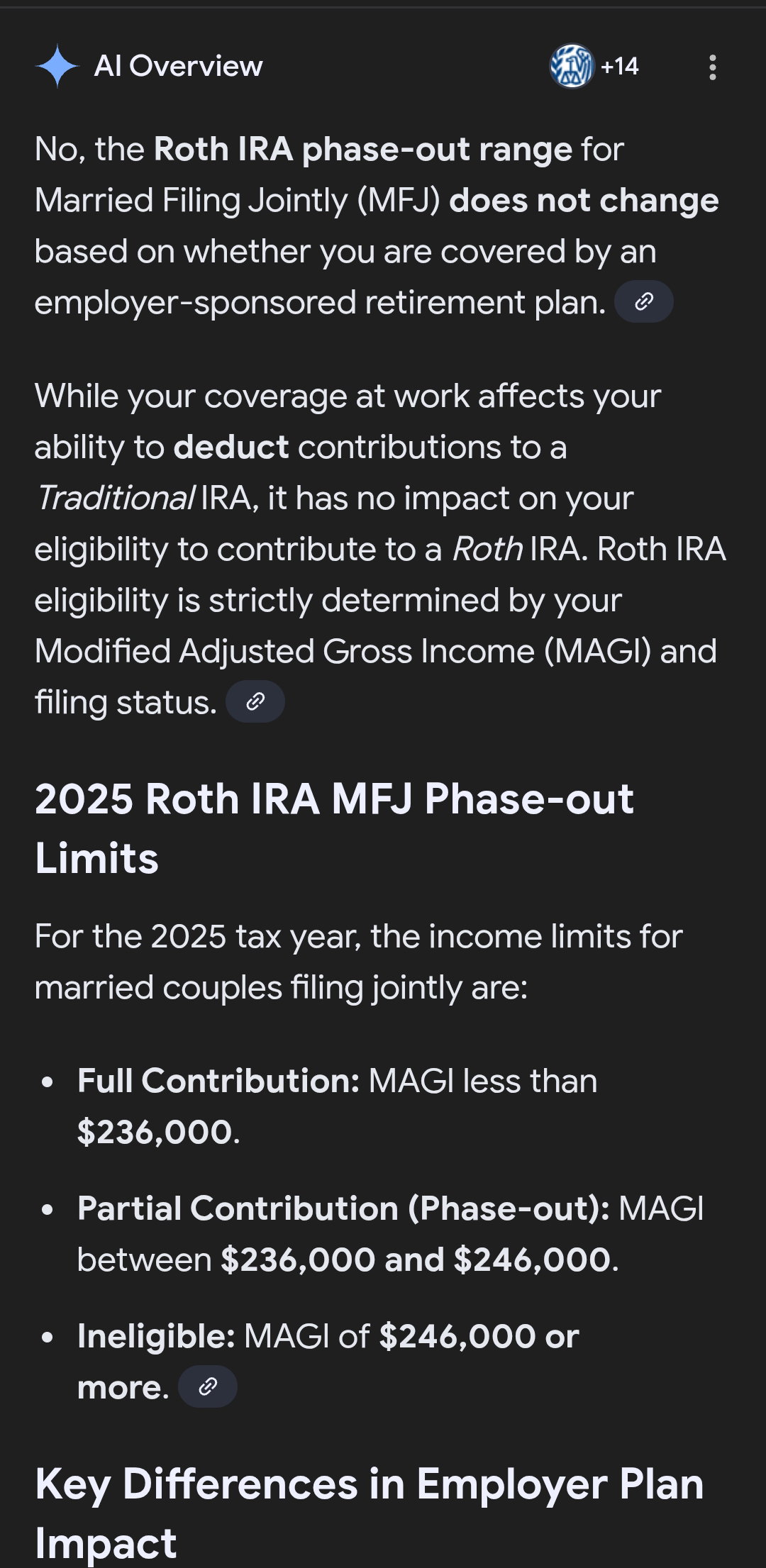
The key thing to realize is that you and your wife might have different cut off amounts. For example, if you are covered by a workplace retirement plan, including a 401(k), but your wife is not, then your phase out range is from $126k-$146k, but your wife's phase out range would be from $236k-$246k. In that case, with the standard deduction, your wife would be fine for a Roth contribution using the normal mechanism, but you would most likely need to make a backdoor Roth contribution.

Your question about income from 2025 being relevant for 2026 investing doesn't make sense to me. If you are asking whether the Roth AGI cut off is applied based on the prior year income for contributions made in the current year, then it most definitely is not. That is, your 2025 IRA contributions (both traditional and Roth) can be made up until the earlier of the tax filing deadline of April 15, or the day your file your tax return. And the determination for eligibility of Roth contributions (and deductibility of traditional contributions) is based on 2025 income for 2025 contributions. Apart from that, I'm not certain what you might be asking.

Showing 5 of 8 replies

View all replies on Community

Comments

Your comment will be posted after signing in
Join the Conversation

Create an account or sign in to post a comment.

Username
Email

No password needed. We'll send a verification email.

Email
Password

Find Your FI Number

Calculate how much you need — takes 60 seconds.

See How Close You Are to FI

Join ChooseFI

Start your financial independence journey

  • Access to the ChooseFI community
  • Exclusive FI resources and tools
  • Weekly actionable insights
or

No password needed — we'll email you a verification link.

Already have an account?

Don't have an account?

Try searching for

⌘K to open anytime

Your FI Journey

1/3

Step 1 of 3

How familiar are you with Financial Independence?