Five-Minute Win
This week's Five-Minute Win: See if you can spot a phishing email.
I was talking with my daughter Molly recently about online security and told her one of my basic rules: I essentially never click a link in an email. If my bank, credit card company, or another account tells me I need to do something, I'll open the app or go directly to the website and log in from there.
Molly told me she had never really thought about that before, which reminded me that some of these little security habits aren't obvious until someone teaches them to you.
Here's another one: Before clicking a link on your computer, hover your mouse over it. Your browser will show you the actual URL the link is sending you to. The words in the email might look completely legitimate while the destination is something else entirely.
Then I saw a phishing quiz from Google in Tim Ferriss's newsletter this week. It shows you a series of emails and asks you to decide whether they're legitimate or phishing attempts.
Take the Google Phishing Quiz.
Even better, when you're done, send it to your kids, parents, or someone else in your family. Five minutes learning to recognize a phishing attempt could save someone from an enormously expensive mistake.
Take five minutes today. Your future self will be glad you did.
The Cost of Doing Business
My younger daughter, Molly, discovered Depop this week, a site where people buy and sell used clothing. This was quite the revelation for someone who likes shopping at places like Lululemon.
She found the same shorts that would cost around $60 new for $15 or $20 used. After scrolling through a few more listings, she announced, “I'm never going to buy something new ever again!”
That led to a conversation about something I think of as the cost of doing business.
Buying used from another person isn't risk-free. Eventually, someone might make an item look a little better in the pictures than it does in person, or something might arrive with more wear than you expected. But I told Molly that you can't evaluate the strategy based on the one transaction that goes wrong.
Imagine she eventually buys ten pairs of $15 shorts for $150. Buying those same ten pairs new might cost $600. Even if one of the ten purchases is a complete dud, she's still enormously better off.
That bad purchase isn't evidence that the strategy failed. It's the cost of doing business.
I've realized I think about grocery delivery the same way. Erin and I have been experimenting with Instacart for Wegmans and Costco, and one of the obvious drawbacks is that someone else is choosing your produce and meat. Every once in a while, I'm going to get an avocado that's riper than I wanted or a cauliflower that's smaller than the one I would have picked.
Each delivery saves me roughly an hour. If I do that once a week, I'm potentially buying back 50 hours of my life every year at the cost of occasionally receiving a $3 avocado I wouldn't have chosen myself.
I think we sometimes abandon really good systems because we're frustrated by an occasional bad outcome. But almost nothing works perfectly. If something works extraordinarily well 90 or 95 percent of the time, the remaining few percent may simply be the price you pay to capture all the value.
A good strategy doesn't have to work perfectly. It just has to work overwhelmingly in your favor.
A Few Things...
A few things I found interesting this week...
🔑 No Keys
One of my favorite tiny upgrades in our new condo is that we don't need keys. Our front door has a code, and so does the garage.
Because we live in such a walkable community and don't drive all that often, Erin and I can leave the condo with basically nothing but our phones. There's almost nothing to grab and no keys to remember.
It gives me this funny feeling that we're on vacation, where you can just walk out of your hotel and wander around for the day. Except this is actually one step better because we don't even need to remember the hotel key card. We just know the code.
It's such a small thing, but I love how frictionless it makes leaving the house.
🎯 Be Curious, Not Judgmental
With Ted Lasso back for Season 4, I've been thinking about one of my favorite scenes from the entire series.
Ted is playing darts against Rupert and tells a story about a quote he'd once seen attributed to Walt Whitman: “Be curious, not judgmental.” Ted's point is that people had underestimated him his entire life because they made assumptions instead of asking questions. If Rupert had simply been curious, he might have asked Ted whether he'd played much darts before challenging him. It turns out Ted had played every Sunday with his dad for years.
I've always loved that scene because it captures something I've increasingly tried to do in my own life. When someone believes something that seems obviously wrong to me, behaves in a way I don't understand, or makes a decision I wouldn't make, I try to ask myself: What am I missing?
That doesn't mean the other person is necessarily right. It just means there might be something about their experience or reasoning that I don't know yet. I've found that asking “What am I missing?” before forming an opinion almost always leaves me understanding the situation a little better.
📱 I Don't Need the Costco Card Either
Last week I mentioned that I'd stopped carrying a traditional wallet and now keep my Costco card in the glove box because, by definition, I'll have my car with me whenever I go to Costco.
A few dozen of you wrote to tell me that the Costco app has a digital membership card with a QR code, and I can even connect my Costco Visa and pay through the app. I downloaded it immediately.
I love two things about this. First, I'm now looking for other cards I can eliminate entirely. I already love using the QR code and automated payment at Whole Foods, recently downloaded the Priority Pass app, and added my ID to Virginia's new mobile ID app. I'm not quite ready to leave my physical REAL ID at home until I'm confident I can use the digital version everywhere I need it, but we're getting there.
More importantly, I love that a few dozen people immediately wrote in with a better solution. That's one of my favorite things about the ChooseFI community.
None of us has figured everything out, but when thousands of people share the little things that work for them, we all get a little better, one percent at a time.
📚 Rediscovering Vonnegut
I've been reading a lot of fantasy lately and decided I wanted to branch out a bit, so I reserved a few Kurt Vonnegut novels from the library.
More than 25 years ago, I probably read seven to ten of his books and loved them. The funny thing is that it's been so long that I've forgotten most of what I read, which means I basically get to discover Vonnegut all over again.
I'm starting with The Sirens of Titan and God Bless You, Mr. Rosewater. I spent some time talking through his books with ChatGPT, and those two seemed particularly relevant to the things I find myself thinking about at this point in my life.
There's something fun about returning to an author you loved decades ago and getting to see whether the books hit differently at 47 than they did in your late teens and early twenties.
⚖️ What Gets Measured Gets Managed
I've been taking my fitness much more seriously since I started working with my trainer, Dean Turner, in early 2023. Lately I've been going it on my own, and while I'm still feeling great, I've noticed my weight slowly starting to creep up again.
One of the best parts of working with Dean was the accountability. Every day I logged my weight, steps, calories, and macronutrients, along with my workouts when applicable.
There was something about having to record those numbers every day that kept me accountable and made it much harder to drift without noticing.
So this week I bought a basic $20 scale from Amazon and I'm going back to consistently tracking my weight. I'd like to lose a few pounds, and I know myself well enough to know that seeing the number every morning will make me more intentional about the decisions I make throughout the day.
There's an old saying that what gets measured gets managed, and I've found that to be true in almost every part of my life. Sometimes getting back on track starts with something as simple as paying attention again.
The Recurring Dollar Audit
One-time effort is unusually valuable when it eliminates recurring spending. Think about the difference between saving $100 on something you buy once and finding a way to save $100 every single month.
Let's say you spend an hour shopping your home and auto insurance and manage to lower your premiums by $100 a month. That's $1,200 a year. And if you're pursuing FI, using the 4% rule, permanently reducing your annual spending by $1,200 means you need $30,000 less invested to support your lifestyle.
Or look at it from the other direction. If you're still accumulating and you invest that $100 every month instead, at an 8% annual return, you'd have roughly $60,000 after 20 years. All because you spent an hour fixing something once.
Insurance is just one example. It could be your cell phone plan, internet, investment fees, bank fees, storage, subscriptions, or anything you signed up for years ago and haven't really thought about since. This isn't about spending your life hunting down every $4 monthly charge. I have no interest in doing that. It's about recognizing that not all savings are created equal.
If I can save $100 once, great. But if I can spend an hour today and save $100 every month for the next five or ten years, that's where I want to spend my attention.
Optimize recurring dollars before one-time dollars.
Here’s something to try: Pull up your latest credit card or bank statement and find the oldest recurring charge you haven't actively reconsidered in at least two years. Circle it. That's your project this week.
Around ChooseFI
A few things happening around the ChooseFI community...
🎉 Community Wins
One of the most-loved parts of the newsletter is the ChooseFI Community Taking Action section, and it only continues to exist because you share your wins. Hit reply to this email and send in your win.
📍 Local Groups
If you haven't already, take 30 seconds to join your local ChooseFI group. You'll automatically receive email notifications about meetups and events in your area, making it easy to connect with other people on the path to FI.
I love seeing how people are using the ChooseFI community platform to build connections: My friends Jay and Bridgett from CampFI recently visited Charleston, SC and they set up an open invite on the app to connect with the local ChooseFI group.
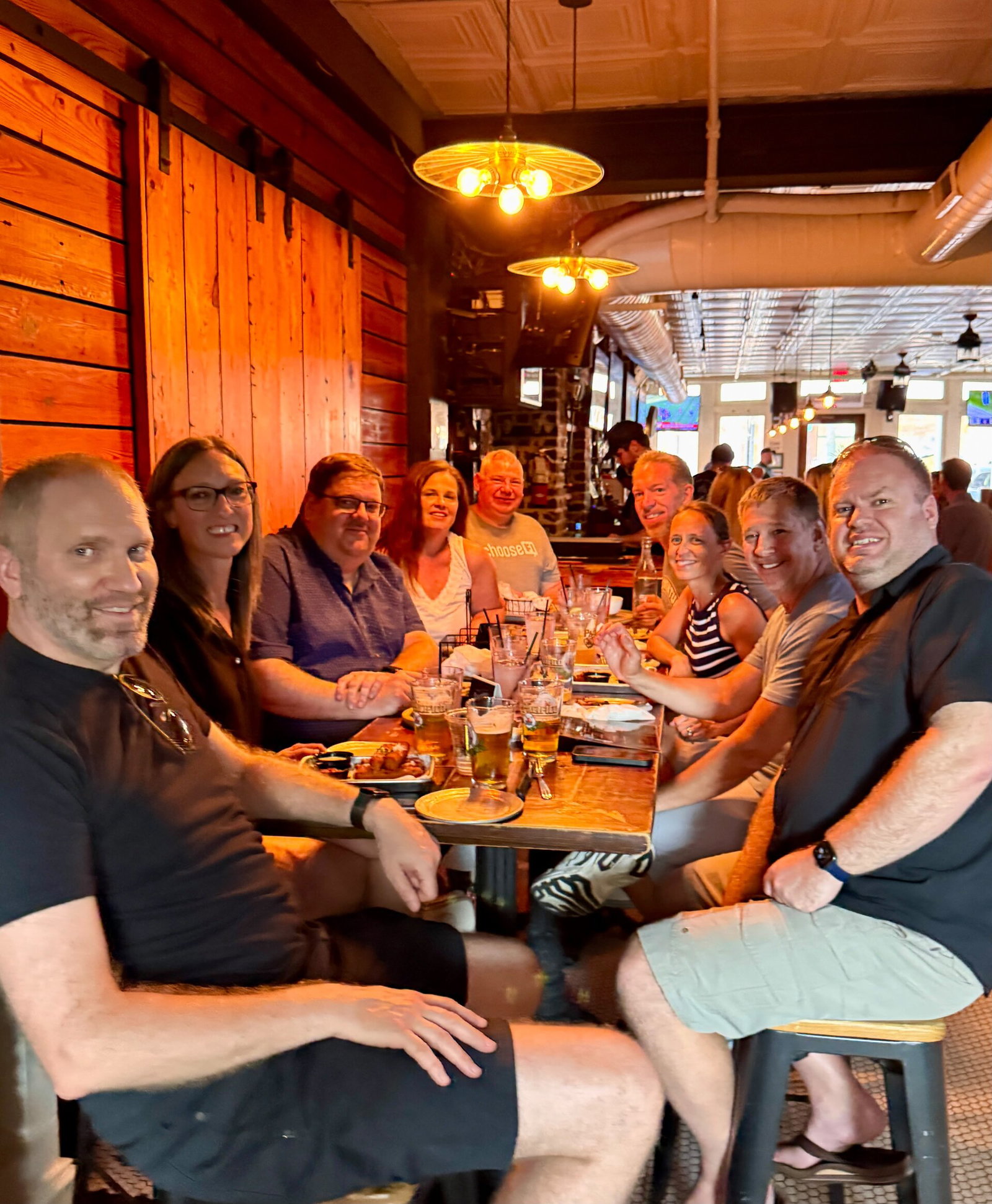
As Jay said, “We had a great turnout and met amazing people, which wouldn't have happened without the community focused foundation you guys have put in place. Just want to express my gratitude.”
🎙️ Continue the Conversation
Have thoughts or questions about this week's podcast? Join the discussion on Episode 614, where Ginger chats with Oz Chen in one of her wonderful ‘Getting Personal with Personal Finance’ episodes.
✈️ Travel Rewards
My Top Ten Recommended Travel Rewards Cards page is always up to date, including current welcome offers. If you're thinking about your next travel rewards card, that's the first place I'd look.
If you apply using our links, ChooseFI earns a commission at no additional cost to you. That support helps keep the podcast and newsletter free, and we're incredibly grateful.