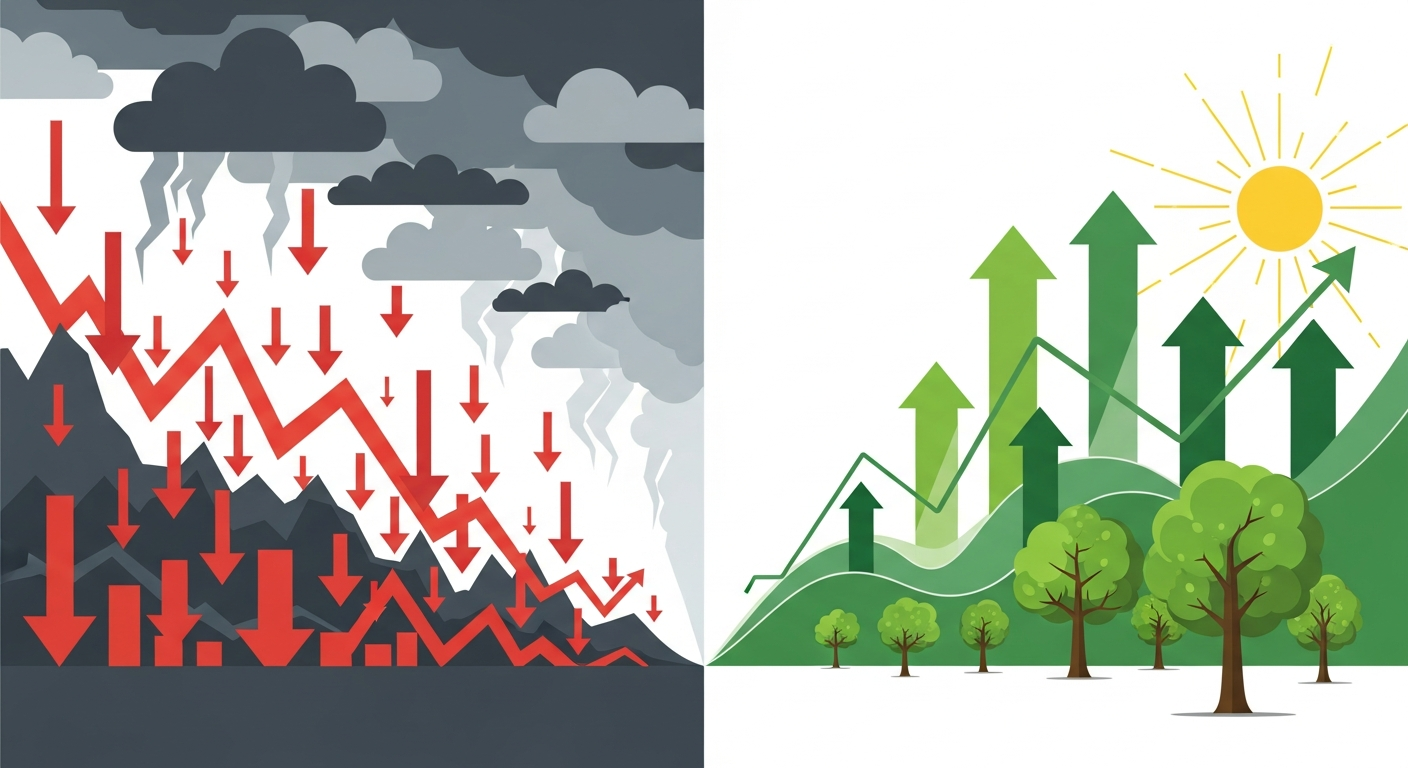
The stock market crashes about once every three years—at least a 20% drop. Most investors panic and sell. But if you understood why markets always recover, you'd do the opposite. Brian Feroldi reveals three mechanical forces that guarantee long-term market resilience, transforming market crashes from terrifying events into predictable opportunities.
Key Topics Discussed
Introduction to Market Resilience (00:00:00)
Brad Barrett introduces the concept of understanding market recovery through fundamental mechanics rather than accepting it on faith.
Understanding Market Crashes (00:05:00)
Brian explains crash frequency: 10% drops every eleven months, 15% every two years, 20% every three years, 30% once a decade, and 40%+ drops two to three times per century.
Force #1: Stocks Follow Earnings (00:10:00)
The first fundamental force—stock prices track corporate earnings over time. Brian introduces the man-and-dog analogy: the man (profits) walks steadily uphill while the dog (prices) runs wild on an elastic leash. Watch the man, not the dog.
Force #2: Earnings Always Recover (00:25:00)
Brian breaks down the five-phase economic recovery process: cost-cutting, cleansing, government intervention, innovation, and emergence.
The Forest Fire Analogy (00:32:00)
Economic downturns function like forest fires—clearing deadwood, eliminating weak competitors, and creating optimal conditions for new growth. The COVID pandemic demonstrated this: remote work jumped from under 10% to over 90% in four months.
Force #3: Profits Rise Over Time (00:48:00)
Five systematic drivers cause profits to rise: productivity gains, inflation, innovation, geographic expansion, and population growth. These forces ensure long-term upward trajectory despite temporary setbacks.
Investor Psychology and Closing Thoughts (00:55:00)
Discussion about investor behavior during crashes and the importance of saving this episode for future market downturns when emotional fortitude matters most.
Notable Quotes
"Stocks follow earnings. As go the earnings of a company or an index, also goes the price or the market value of that same index." — Brian Feroldi
"The best time to buy is at the period of maximum pessimism. And the period of maximum pessimism is precisely when you absolutely do not want to buy." — Brian Feroldi
"Ninety percent of good investing is how you behave in the 10% of time that things are not going well." — Brian Feroldi
"Think of the man walking a dog on an elastic leash. The man represents profits, the dog represents stock prices. Watch the man, not the dog." — Brian Feroldi
"Innovation accelerates when times are tough. Necessity is the mother of invention." — Brad Barrett and Brian Feroldi
Key Takeaways
- Google "S&P 500 earnings" and study the 100-year chart showing earnings rather than just stock prices to see the steady upward march of the "man"
- Save this episode in your investor policy statement to re-listen during the next market crash when you need psychological reinforcement
- Set up automatic dollar-cost averaging contributions to retirement accounts and commit to never stopping them during downturns
- Review your asset allocation if you're within 10 years of financial independence to ensure appropriate risk levels and cash cushions
- Markets typically bottom when news is worst because prices predict earnings recovery 6-9 months ahead
Resources and Links
- Why Does the Stock Market Go Up? by Brian Feroldi
- The Simple Path to Wealth by JL Collins
- JL Collins Guided Meditation for Market Drops
- Afford Anything Podcast with Paula Pant
- Camp FI
- Brian Feroldi on YouTube
- Brian Feroldi on Twitter/X
- Brian Feroldi on Instagram
- Brian Feroldi on Threads

Top Travel Card
Ready to unlock a world of free travel? Start with the Chase Sapphire Preferred® Card
$95 annual fee | Earn 100,000 bonus points

Best Card for Side Hustlers and Business Owners
Side hustlers! With the Ink Business Preferred® Credit Card you can earn free travel from your business expenses.
$95 annual fee | Earn 100,000 bonus points

Most Flexible Travel Card
The Capital One Venture Rewards Credit Card can be used to offset almost any travel expense.
$95 annual fee | Earn 75,000 Miles once you spend $4,000 on purchases within 3 months from account opening
ChooseFI has partnered with CardRatings for our coverage of credit card products. ChooseFI and CardRatings may receive a commission from card issuers.