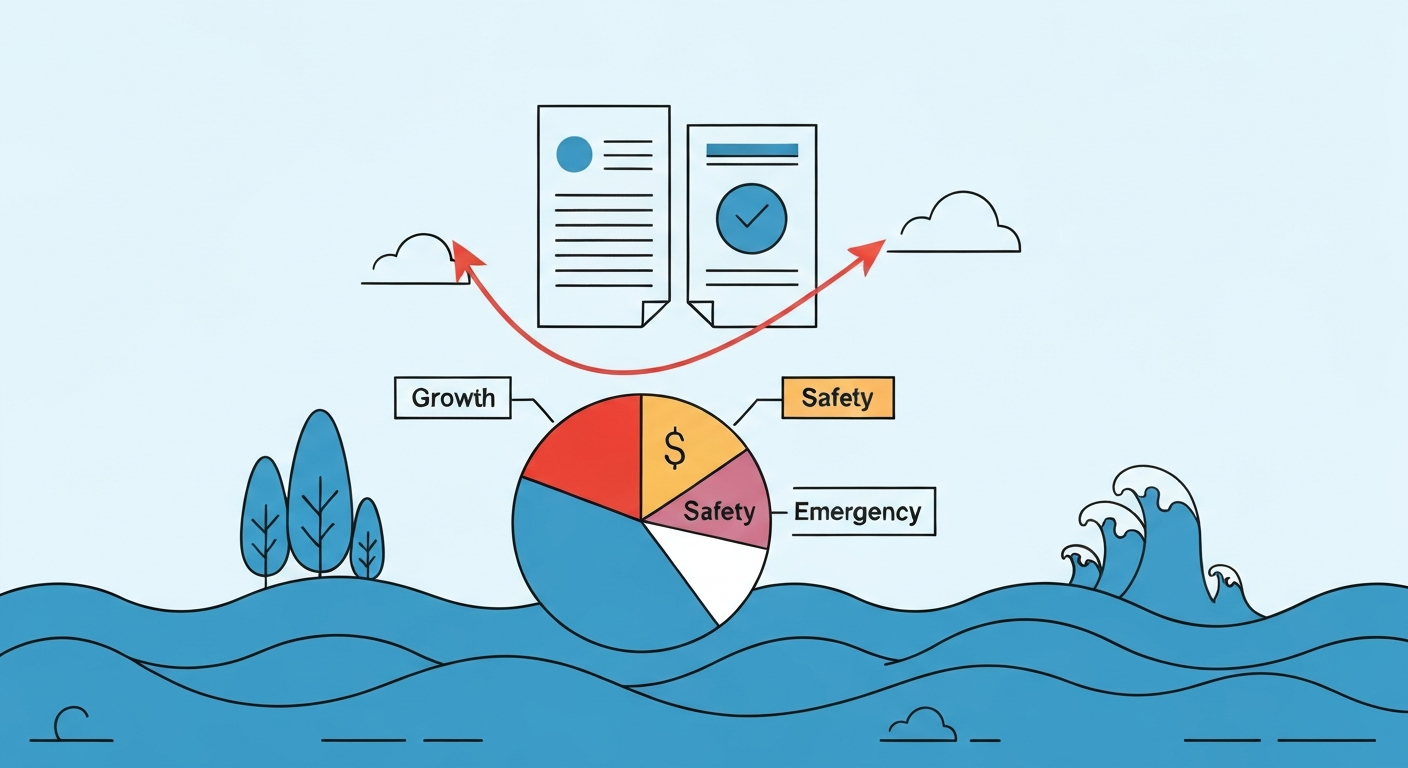
Most investors lose to the market because they're trying to pick winners in a game where only 4% of stocks have created 100% of market wealth over the past century. The math isn't in your favor—but there's a simpler path that is.
Key Topics Discussed
Introduction to FI 201 (00:00:00)
Jonathan introduces the concept of Financial Independence 201, explaining how it builds on FI 101 to help individuals progress from control to optimization and independence on their FI journey.
The Genesis of FI 201 (00:05:30)
Allen and Kristen explain how they identified the need for a 201-level presentation based on questions emerging from their St. Louis FI 101 sessions, particularly around investing concepts.
Asset Allocation Fundamentals (00:15:00)
Allen breaks down asset allocation as 'your money pie,' discussing how to balance growth, safety, and emergency funds while considering time horizons and diversification strategies.
Risk Tolerance vs Risk Capacity (00:22:00)
The team explores the critical difference between emotional risk tolerance and actual risk capacity, using examples from 2008 and 2020 market crashes to illustrate real-world application.
Tax-Advantaged Account Strategies (00:35:00)
Allen and Brad discuss the various tax treatments of investment accounts including 401(k)s, 457(b)s, Roth IRAs, HSAs, and taxable brokerage accounts, emphasizing lifetime tax optimization.
Individual Stocks vs Index Funds (00:48:00)
The hosts examine the data on individual stock picking, revealing that only 4% of stocks have contributed to 100% of market wealth over the past century, making a strong case for index investing.
Dividends and Tax Control (00:55:00)
Brad and Allen discuss why the FI community often prefers capital gains over dividend income, focusing on the importance of maintaining control over when and how you realize taxable events.
Notable Quotes
"You can't save your way to FI, you have to invest." — Allen Hansen
"When there's a dip, you essentially get to buy the market on sale. If you love a bargain, this is it." — Brad Barrett
"Why in the world do we not think that way when it comes to the market? Our brain completely flips. We're like, ah, we're scared." — Kristen Knapp
"It's not what's my tax this year. It is what is going to be my tax burden over my lifetime." — Brad Barrett
"The best investing lesson: stand there and do nothing. If you're invested, just don't do anything and you're going to be rewarded." — Allen Hansen
Key Takeaways
- Assess your own risk tolerance and risk capacity honestly by considering how you would react to a 30% portfolio drop
- Review your current asset allocation across all accounts and determine if it aligns with your time horizon and financial goals
- Calculate the difference between your marginal and effective tax rates to understand your true tax burden
- Identify which tax-advantaged accounts you have access to (401k, 457b, 403b, HSA, IRA) and ensure you're maximizing employer matches
- Track every dollar of taxable income if you're on ACA subsidies or approaching any subsidy cliffs to avoid losing benefits
- Consider whether you have the right balance between taxable, tax-deferred, and tax-free accounts for maximum flexibility in retirement
- Join or start a local FI group to benefit from community wisdom and learn from others at different stages of the journey
- Review your portfolio for dividend-heavy investments and consider whether you'd prefer more control over when you realize taxable events
Resources & Links
- FI Friends Travel
- The Simple Path to Wealth by J.L. Collins
- Tax Planning to and Through Early Retirement by Sean Mullaney and Cody Garrett
- ChooseFI Community App
- St. Louis FI Group
- BlackBerry Documentary (Netflix)
- Arizona State University Stock Market Wealth Study
- Brian Feroldi (individual stock investing advocate)
- Investopedia
Top Travel Card
Ready to unlock a world of free travel? Start with the Chase Sapphire Preferred® Card
$95 annual fee | Earn 100,000 bonus points
Best Card for Side Hustlers and Business Owners
Side hustlers! With the Ink Business Preferred® Credit Card you can earn free travel from your business expenses.
$95 annual fee | Earn 100,000 bonus points
Most Flexible Travel Card
The Capital One Venture Rewards Credit Card can be used to offset almost any travel expense.
$95 annual fee | Earn 75,000 Miles once you spend $4,000 on purchases within 3 months from account opening
ChooseFI has partnered with CardRatings for our coverage of credit card products. ChooseFI and CardRatings may receive a commission from card issuers.