

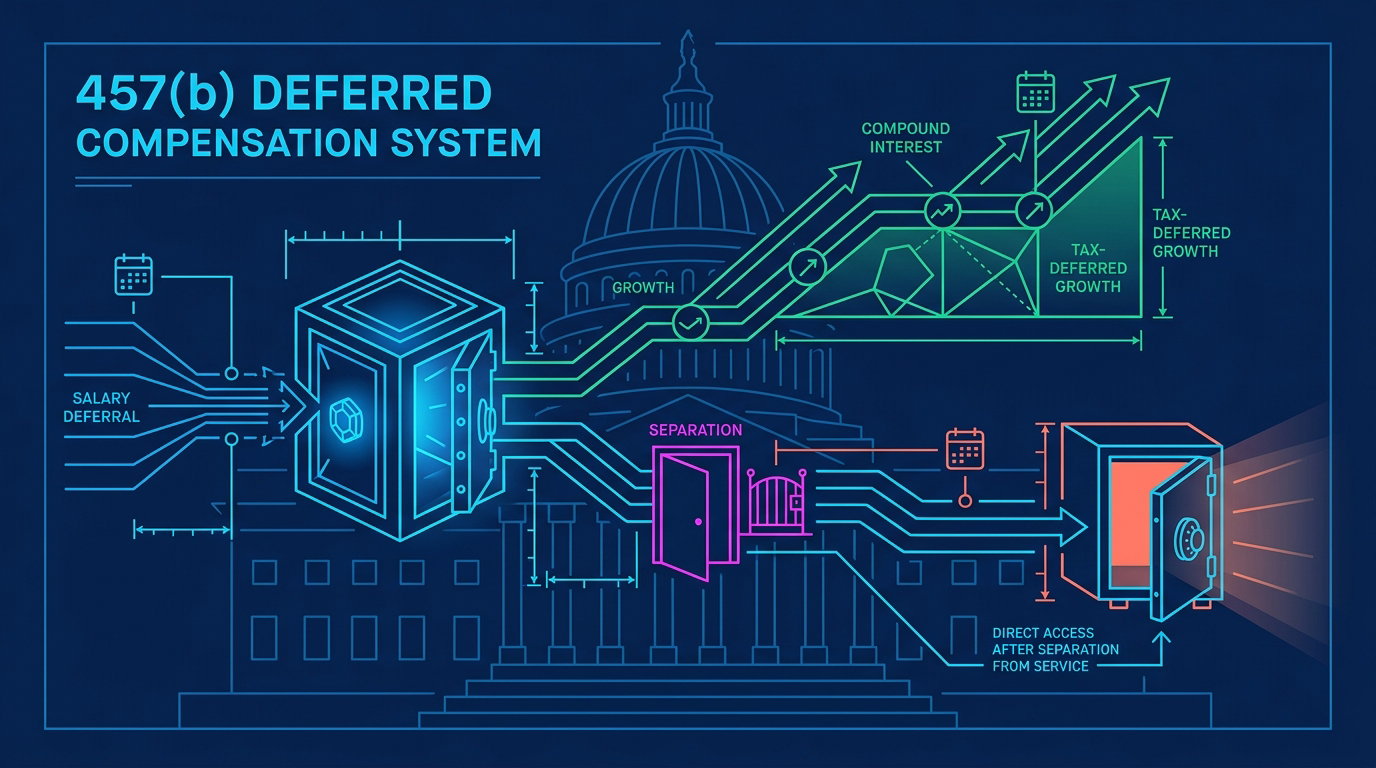
Key Takeaways
- A 457(b) is a deferred compensation plan for government and certain nonprofit employees with NO early withdrawal penalty — the single best account for early retirement access
- The 2026 contribution limit is $24,500 ($31,000 with age 50+ catch-up), and you can contribute to BOTH a 457(b) and a 403(b) simultaneously
- Governmental 457(b) plans can be rolled into IRAs and other retirement accounts; non-governmental plans cannot
- The 457(b) is the FIRE community's secret weapon because you can access funds at any age after separation from service without the 10% penalty
What's your FI number? Calculate it in 60 seconds
The one number that changes everything
457(b) Plan at a Glance
What Is a 457(b) Deferred Compensation Plan?
A 457(b) plan is an employer-sponsored retirement savings account available to state and local government employees and certain nonprofit (tax-exempt) organizations. It operates similarly to a 401(k) or 403(b) — you defer a portion of your salary before taxes, your money grows tax-deferred, and you pay income tax when you withdraw.
But here is where the 457(b) separates itself from every other retirement account: there is no 10% early withdrawal penalty. None. Zero. Once you leave your employer — whether you retire at 35 or 65 — you can access your 457(b) funds immediately and pay only ordinary income tax. No penalty, no waiting until age 59 and a half, no complicated Roth conversion ladders.
This single feature makes the 457(b) the most powerful account for anyone pursuing financial independence through government employment. Teachers, firefighters, police officers, state university employees, city workers, and county staff all potentially have access to this account. If you have a 457(b) available and you are not maxing it out, you are leaving the best early-retirement tool on the table.
The plan comes in two flavors: governmental 457(b) plans and non-governmental (tax-exempt) 457(b) plans. The differences are significant and affect rollover options, creditor protection, and how your money is held.
| Feature | Governmental 457(b) | Non-Governmental 457(b) |
|---|---|---|
| Eligible employers | State/local government | Tax-exempt nonprofits |
| Assets held in | Trust for the employee | General assets of employer |
| Rollover to IRA | Yes | No |
| Creditor protection | Protected (like a 401k) | Subject to employer creditors |
| Early withdrawal penalty | None after separation | None after separation |
| Catch-up at 50+ | Yes ($7,500 additional) | Yes ($7,500 additional) |
| Special 3-year catch-up | Yes (up to $47,000/yr) | Yes (up to $47,000/yr) |
Start Your FI Journey Today
Free calculators, a personalized FI roadmap, and a community of 25K+ on the same journey.
Create a free account to get started
2026 457(b) Contribution Limits and the Double-Dip Strategy
The 2026 457(b) contribution limit is $24,500 — the same as 401(k) and 403(b) limits. If you are age 50 or older, you can contribute an additional $7,500 catch-up, bringing your total to $31,000.
But the real power move is the double-dip strategy. The 457(b) has its own separate contribution limit from the 403(b). If your employer offers both plans — and many government and university employers do — you can max out both accounts in the same year. That means $24,500 into your 457(b) plus $24,500 into your 403(b) equals $47,000 per year in tax-deferred savings, not counting employer matches or catch-up contributions.
For a dual-income household where both partners have access to 457(b) and 403(b) plans, the combined tax-deferred savings potential exceeds $94,000 per year. Add HSA contributions, Roth IRAs, and any employer matches, and a government-employed couple can shelter well over $100,000 annually from taxes.
| Scenario | 457(b) | 403(b) | Total Tax-Deferred |
|---|---|---|---|
| Single, under 50 | $24,500 | $24,500 | $47,000 |
| Single, 50+ | $31,000 | $31,000 | $62,000 |
| Married, both under 50 | $47,000 | $47,000 | $94,000 |
| Single, 3-year catch-up | $47,000 | $24,500 | $70,500 |
The Special 3-Year Catch-Up Provision
The 457(b) offers a unique catch-up rule that no other retirement plan has. In the three years before your plan's "normal retirement age" (typically 65 or 70, defined by your employer), you can contribute up to double the regular limit — that is $47,000 in 2026. This provision lets late starters make up for years of lower contributions. You cannot use both the age-50 catch-up and the 3-year catch-up in the same year — you must choose whichever is larger.
This provision requires careful planning because the normal retirement age varies by employer and plan document. Review your specific plan to confirm your eligible catch-up window.
Build Your FI Plan
Map your path to financial independence with personalized calculators and milestone tracking.
- Save your progress
- Get personalized next steps
- Access calculators and resources
You're in!
Check your email to get started with your FI Plan.
457(b) Rollover Rules and Investment Considerations
Governmental vs Non-Governmental Rollovers
This distinction matters enormously. Governmental 457(b) balances can be rolled into a Traditional IRA, 401(k), 403(b), or another governmental 457(b) after you separate from service. This gives you full flexibility to consolidate accounts, access better investment options, and implement tax-efficient withdrawal strategies in retirement.
Non-governmental 457(b) plans — those offered by tax-exempt nonprofits like hospitals, charities, and private universities — cannot be rolled into an IRA or any other retirement plan type. The balance can only be rolled to another non-governmental 457(b). This limitation is critical to understand before relying on a non-governmental 457(b) as a cornerstone of your retirement strategy.
Even more concerning: non-governmental 457(b) assets are held as general assets of the employer, meaning they are technically subject to the employer's creditors. If your nonprofit employer faces financial trouble, your deferred compensation could be at risk. Governmental plans hold assets in trust for the benefit of employees, providing the same creditor protection as a 401(k).
Investment Options Inside a 457(b)
Most governmental 457(b) plans offer a menu of mutual funds, target-date funds, and sometimes a self-directed brokerage window. The quality of investment options varies dramatically between plans. Look for low-cost index fund options — total stock market, S&P 500, total international, and total bond market funds with expense ratios below 0.10% are the gold standard.
| Investment Option | What to Look For | Red Flag |
|---|---|---|
| Index funds | Expense ratio under 0.10% | Ratios above 0.50% |
| Target-date funds | Low-cost (Vanguard, Fidelity) | High-fee proprietary funds |
| Self-directed brokerage | Full market access | High per-trade fees |
| Stable value fund | 2-3%+ return, no market risk | Surrender charges |
| Annuity options | Rarely appropriate | High fees, surrender periods |
If your plan's investment options are poor — loaded with high-fee actively managed funds — contribute enough to capture any match, then prioritize your 403(b) or IRA if those have better options. After separation, roll the 457(b) balance to a low-cost IRA provider like Vanguard or Fidelity.
How to Maximize Your 457(b) for Early Retirement
A step-by-step plan for government employees pursuing FIRE.
Confirm Your Plan Type: Governmental or Non-Governmental
15 minutesCheck with your HR department whether your 457(b) is a governmental plan (state/local government employer) or a non-governmental plan (tax-exempt nonprofit). This determines your rollover options and creditor protection.
Pro tip: If you have a non-governmental 457(b), consider limiting contributions to what you can access penalty-free and prioritizing other accounts for the rest.
Check If Your Employer Also Offers a 403(b)
10 minutesMany government and university employers offer both a 457(b) and a 403(b). If both are available, you can contribute the maximum to each — doubling your tax-deferred savings to $47,000+ per year.
Max Out Your 457(b) Contributions
20 minutesContribute the full $24,500 for 2026 ($31,000 if 50+). Set up automatic payroll deductions and increase them annually until you reach the maximum.
Pro tip: Front-load contributions early in the year if your employer allows it — more time in the market beats dollar-cost averaging on average.
Select Low-Cost Index Fund Investments
30 minutesChoose the lowest-cost index funds available in your plan. A simple two-fund or three-fund portfolio (total US stock market + total international + total bond) keeps fees low and diversification high.
Plan Your Separation and Withdrawal Strategy
1 hourWhen you reach your FI number, your 457(b) balance is immediately accessible after separation from service with no penalty. Plan your withdrawal rate alongside any other income sources (Roth IRA, taxable brokerage, rental income) to minimize your tax bracket.
Pro tip: Consider partial withdrawals from the 457(b) to fill lower tax brackets while doing Roth conversions on your 403(b) or Traditional IRA balances.
Find Your FI Number
See where you stand and model your path to financial independence with our free calculator.

You're in!
Check your email to get started with your FI Number.
Frequently Asked Questions
No. While both are employer-sponsored retirement plans with the same contribution limit ($24,500 for 2026), the 457(b) has a critical advantage: no 10% early withdrawal penalty after you separate from your employer. A 401(k) charges a 10% penalty on withdrawals before age 59 and a half (with limited exceptions). The 457(b) also has a unique 3-year catch-up provision that allows double contributions near normal retirement age.
Yes. The 457(b) has a separate contribution limit from the 403(b) and 401(k). If your employer offers both plans, you can contribute the maximum to each — that is $24,500 + $24,500 = $47,000 in tax-deferred savings for 2026, not counting catch-up contributions or employer matches.
For governmental 457(b) plans, you can roll the balance into a Traditional IRA, 401(k), 403(b), or another governmental 457(b). For non-governmental 457(b) plans, you can only roll into another non-governmental 457(b) — you cannot move the money to an IRA. This is one of the most important differences between the two plan types.
Correct — there is no 10% early withdrawal penalty on 457(b) distributions taken after you separate from service, regardless of your age. You will owe ordinary income tax on the withdrawal, but no penalty. This is why the FI community considers the 457(b) the single best account for early retirement access. The penalty-free access applies to both governmental and non-governmental plans.
Yes. The 457(b) and Roth IRA have completely separate contribution limits and eligibility rules. You can max out your 457(b) ($24,500) and your Roth IRA ($7,000, or $8,000 if 50+) in the same year, subject to Roth IRA income limits. If your income exceeds Roth limits, use the backdoor Roth strategy.
In the three years before your plan's normal retirement age, you can contribute up to double the regular limit — $47,000 in 2026. This is separate from the age-50 catch-up ($7,500). You cannot use both in the same year; you choose whichever is larger. The normal retirement age is defined by your plan document and typically ranges from 65 to 70.
The Bottom Line
The 457(b) is the single most powerful retirement account for early retirement access. No other plan lets you withdraw your full balance at any age after leaving your employer without a 10% penalty. If you are a government employee pursuing financial independence, maxing your 457(b) should be your top priority — especially if you can double-dip with a 403(b) for up to $47,000 in annual tax-deferred savings. The 457(b) eliminates the need for complicated Roth conversion ladders or SEPP/72(t) distributions, giving you clean and immediate access to your money the moment you walk away from your job.
2026 Limit
$24,500
Early Penalty
None
Double-Dip Max
$47,000+

