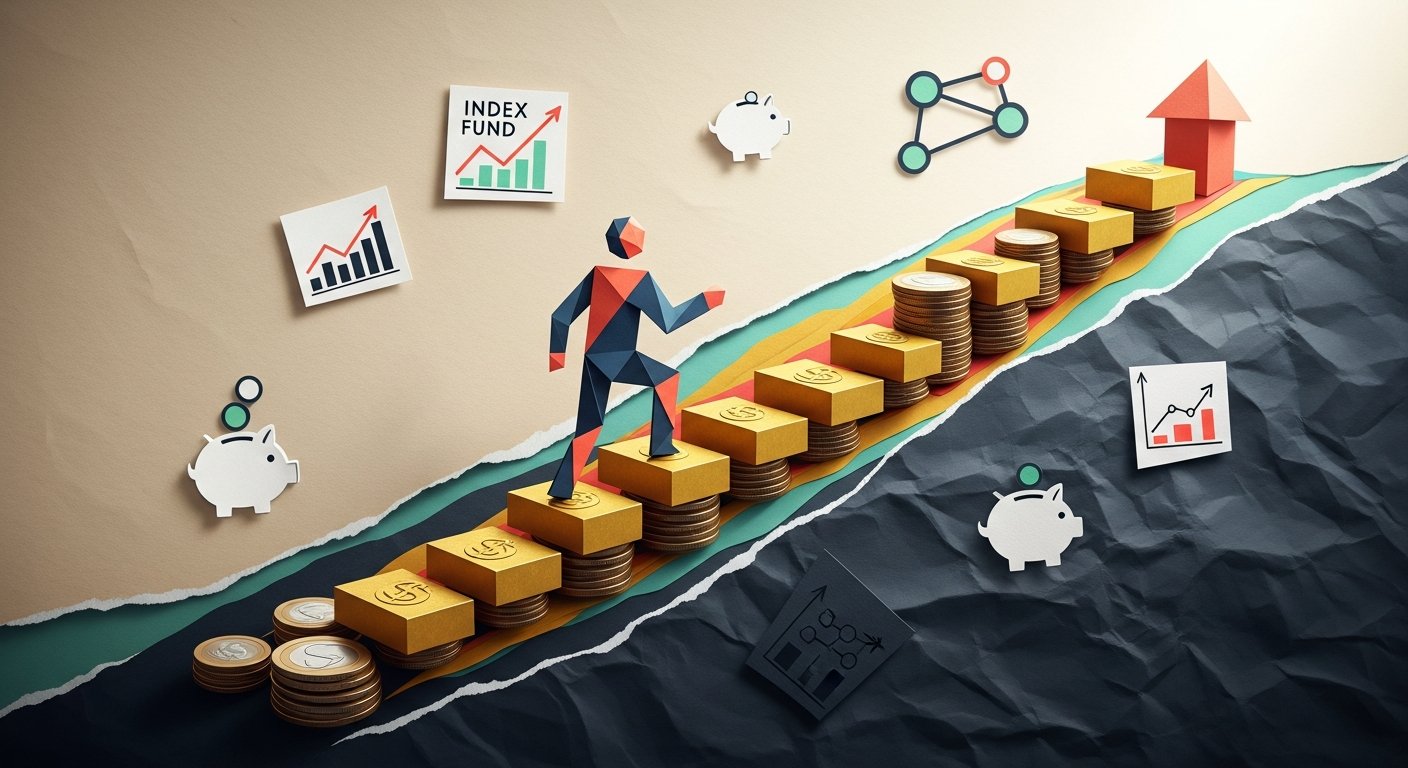
Key Takeaways
- You can start investing with as little as $1 — fractional shares eliminated the barrier to entry.
- Time in the market beats timing the market. Starting with $50/month at 22 beats starting with $500/month at 32.
- One total market index fund (VTI, VTSAX, or FSKAX) is all you need to start. Add complexity later if you want.
- The first $100K is the hardest — after that, compound growth starts contributing more than your own savings.
Brokerage Account Minimums Compared (2026)
You no longer need thousands of dollars to open an account — here's what the three major brokerages actually require today
| Fidelity | Schwab | Vanguard | |
|---|---|---|---|
| Account Minimum | $0 | $0 | $0 |
| Fractional Shares | Yes — $1 minimum | Yes — $1 minimum | Yes — ETFs only |
| Stock & ETF Commissions | $0 | $0 | $0 |
| Index Funds Available | Yes — broad selection | Yes — broad selection | Yes — including proprietary funds |
| Best For | Beginners with small balances | Beginners and active investors | Long-term index fund investors |
Fidelity
Schwab
Vanguard
Where Is Your Money Going?
Our free Expense Audit tool breaks down your spending by category and reveals exactly where you can save more. Create a free account to start.
- Category-by-category spending breakdown with visual charts
- Savings potential analysis — see where you can cut without pain
- Track spending month over month and celebrate wins
Free forever — no credit card required
Monthly Spending
$4,180
Potential savings: $620/mo identified
Spending by Category
$4,180
Spending
$620
Can Save
$7,440
Per Year
Preview — create free account to use
Why starting now beats starting later — even with less
Time is your greatest asset. The math proves it.
Find your FI number in 60 seconds
Free calculator shows when you could reach financial independence — plus a savings rate tracker, expense audit, and more.
The Compound Growth Math That Changes Everything
Here's the thing most people miss about investing with little money: the amount matters less than you think. What actually matters is time. Let the math show you what we mean.
What $50/Month Becomes
Fifty dollars a month feels almost too small to bother with. But at a 7% average annual return — a reasonable long-term assumption for a diversified index fund portfolio — here's what happens:
- 10 years: ~$8,654
- 20 years: ~$26,047
- 30 years: ~$61,070
Pause on that 30-year number. You put in $18,000 of your own money over those three decades. The other $43,000 came from growth alone. You didn't earn it. You didn't work for it. The market did the heavy lifting while you went about your life.
That's not a trick. That's compound interest — and it's the core reason that figuring out how to start investing with little money is one of the highest-leverage decisions you can make right now.
What $100/Month Becomes
Double the contribution and the results do more than double, because time amplifies everything:
- 10 years: ~$17,308
- 20 years: ~$52,093
- 30 years: ~$122,139
One hundred dollars a month is a skipped dinner out, a trimmed streaming subscription, or a small freelance gig. For a lot of people, it's genuinely findable. And at 30 years, that $36,000 in contributions becomes over $122,000. Your future self won't remember the sacrifices. They'll just have the money.
What $500/Month Becomes
This is where the numbers start to feel like real financial independence territory:
- 10 years: ~$86,541
- 20 years: ~$260,464
- 30 years: ~$610,698
Now consider this: $610,000 invested, using the 4% withdrawal rule, generates roughly $24,400 per year in passive income — indefinitely. That's the kind of number that starts to replace a paycheck. It's not hypothetical FI math; it's what consistent, boring, index fund investing actually produces over time.
If you're learning how to invest with little money right now, you're building the foundation for exactly this outcome. The best way to invest small amounts of money isn't complicated — it's consistent.
The Real Lesson: Time Beats Amount
Here's the argument that should end the "I'll invest more when I earn more" debate permanently.
Take two people:
- Person A invests $200/month starting at age 25
- Person B invests $400/month starting at age 35
Person B invests twice as much per month. But Person A starts 10 years earlier. By their mid-50s, Person A's portfolio crosses over and stays ahead — despite contributing half as much per month — because those first 10 years of compounding are irreplaceable.
That's not an edge case. That's how the math works every time. The most expensive financial decision most people make isn't buying a car or overpaying for rent. It's waiting.
Micro investing apps and low-minimum brokerages exist precisely so that "I don't have enough to start" is no longer a real barrier. How to start investing with no money is a question with an actual answer now — and it starts with $5, $25, or $50 a month in a low-cost index fund.
Want to see how your savings rate fits into the bigger picture? Read our guide on How To Calculate Your Savings Rate to connect these numbers to your own timeline.
Pros & Cons
- Total market index funds give you instant diversification — owning a tiny slice of every publicly traded U.S. company with a single purchase, no research required
- Expense ratios are rock-bottom: FZROX charges 0.00%, FSKAX charges 0.015%, and VTI/VTSAX sit around 0.03-0.04% — you keep almost every dollar you earn
- No stock-picking, no guessing, no watching financial news — one fund and consistent contributions is a complete, proven strategy
- Available at major brokerages (Vanguard, Fidelity, Schwab) with no minimums on most accounts, so you can start with whatever you have today
- Fidelity's FZROX has a $0 minimum investment, making it one of the most accessible starting points for anyone investing with little money
- Decades of evidence back index fund investing — the FI community leans on this approach precisely because it consistently outperforms most actively managed funds over the long term
- Simple to automate — set a recurring contribution and the compounding works in the background without any ongoing decisions from you
- Total market index funds include the entire market, so when the market drops, your balance drops too — there's no defensive positioning built in
- Returns are average by design — you will never beat the market with this approach, because you are the market
- FZROX is exclusive to Fidelity accounts, so it can't be transferred in-kind to another brokerage if you switch later
- For very small balances (under $500), even a 0.03% expense ratio is negligible — but so are the dollar returns, which can feel discouraging before the habit clicks
- A single total market fund is U.S.-focused (for VTI/VTSAX/FSKAX) — some investors prefer adding international exposure for broader diversification
- Requires patience — the real power of index fund investing shows up over decades, not months, which can be hard to stay committed to early on
5 Ways to Start Investing with Little Money
You don't need thousands of dollars to start investing. You need a plan and a first step. Here are five concrete ways to put money to work — even if you're starting with $25, $50, or literal spare change.
1. Your Employer's 401(k) — Even $25 Per Paycheck
If your employer offers a 401(k) match and you're not contributing enough to get it, you're leaving free money on the table. That's not a cliché — it's math.
Here's how it works: say you contribute $50 per paycheck and your employer matches 50% of that. You're not investing $50 — you're investing $75. That's a 50% instant return before the market does anything at all. Over a full year with 26 pay periods, that's $1,950 invested from just $1,300 out of your pocket.
This is the single highest-ROI financial move most people ignore.
For simplicity, choose a target-date index fund inside your 401(k). Pick the one closest to the year you plan to retire — something like a 2026 or 2026 fund. It automatically rebalances as you age. You set it once and let it run.
Start with whatever you can — even $25 per paycheck. Increase it by 1% each time you get a raise. You won't miss money you never saw in your checking account.
2. A Roth IRA with $50 per Month
A Roth IRA is one of the most powerful accounts available to everyday investors. You contribute after-tax dollars, your money grows tax-free, and in retirement you pay zero taxes on withdrawals. You can also withdraw your contributions (not earnings) at any time without penalty — making it more flexible than most people realize.
For 2026, the contribution limit is worth checking directly with the IRS or your brokerage, as it adjusts periodically — but the good news is that you don't need to hit the max to benefit. Even $50 a month adds up.
Open a Roth IRA at Fidelity, Schwab, or Vanguard — all three have $0 account minimums. Once it's open, buy a single total market index fund (like FSKAX at Fidelity or SWTSX at Schwab). Set up an automatic monthly contribution so it pulls from your checking account without you having to think about it.
Automate it, forget it, check it once a year.
Want the full walkthrough? Read Investing 101: How to Start Investing the FI Way.
3. Fractional Shares Through a Brokerage App
Here's a problem that used to exist: a single share of some ETFs costs hundreds of dollars. That made it hard to invest small amounts without leaving cash sitting idle.
Fractional shares solved that. You can now buy $10 worth of a $500 ETF. You own a piece of it — and you participate in its gains (and losses) proportionally.
If you're going this route, consider fractional shares of broad market ETFs like VTI (Vanguard Total Stock Market) or VOO (Vanguard S&P 500) — not individual stocks. Single stocks carry significantly more risk and don't fit the index-fund-first philosophy that drives long-term FI success.
Fidelity and Schwab both support fractional share investing. Start with whatever amount you have right now.
For more on the mechanics: How to Invest Money: A Beginner's Guide to FI.
4. Micro-Investing Apps (Like Acorns)
Apps like Acorns use round-ups to invest your spare change automatically. You spend $3.75 on a coffee, it rounds up to $4.00, and invests $0.25 without you doing a thing. It sounds small because it is — but the habit it builds is real.
The pros: near-zero friction, works in the background, gets you in the habit of investing before you feel ready.
The cons: fees are high relative to small balances. Acorns charges $3/month on some plans. If your balance is $100, that's a 36% annual fee — which no investment return will overcome. As your balance grows, that fee becomes less significant, but it's worth knowing upfront.
The ChooseFI take: micro-investing apps are excellent training wheels. Use them to build the habit and the muscle memory. But as soon as you can, graduate to a Roth IRA with a low-cost index fund. The habit is the point — the app is not the destination.
See our full breakdown: Acorns Review.
5. DRIP — Dividend Reinvestment Plans
A DRIP (Dividend Reinvestment Plan) automatically takes any dividends your investments pay out and uses them to buy more shares — without you doing anything.
For small investors, this is especially powerful. Instead of receiving a $4.00 dividend payment that sits in your account doing nothing, it quietly buys more fractional shares. Those shares generate their own future dividends. That's compounding doing its work in the background.
Most broad-market index funds and ETFs — including VTI, VOO, and their mutual fund equivalents — offer automatic dividend reinvestment. At Fidelity, Schwab, and Vanguard, you can enable this in your account settings in about 30 seconds.
It won't make you rich overnight. But over 20 or 30 years, reinvested dividends can account for a significant portion of your total returns.
Learn more about how it works: DRIP Investing.
The Bottom Line
Investing with little money isn't a consolation prize — it's exactly how most people who reach FI got started. The amount matters less than the consistency. Pick one method from this list, start this week, and add to it over time. The math will do the rest.
Start Your FI Journey Today
Free calculators, a personalized FI roadmap, and a community of 25K+ on the same journey.
Create a free account to get started
Where to Open Your First Investment Account
Choosing the right account doesn't have to be complicated. For most people starting out with small amounts, a handful of brokerages consistently stand out — and all of them have eliminated the biggest barrier: account minimums.
Best Brokerages for Small Investors in 2026
Here's a quick comparison to help you pick one and move forward:
| Brokerage | Best For | Minimum | Fractional Shares | Standout Feature |
|---|---|---|---|---|
| Fidelity | Overall | $0 | Yes | Zero-fee index funds (FZROX) |
| Schwab | All-in-one | $0 | Yes | Excellent research tools |
| Vanguard | Index fund purists | $0 | ETFs only | Founded by Jack Bogle (index fund pioneer) |
All three are solid. If you genuinely have no preference, Fidelity is a strong default — their FZROX fund charges 0% in annual fees, which means every dollar you put in is working for you, not being skimmed off the top.
Vanguard is beloved in the FI community because Jack Bogle literally invented the index fund as we know it. It's less beginner-friendly on the interface side, but the philosophy behind it is sound. Want a deeper breakdown? Check out the Vanguard Review and the Best Investing Apps For Each Level for a side-by-side look across more platforms.
Account Types Explained (30 Seconds Each)
Once you've picked a brokerage, you'll need to choose an account type. Here's what actually matters:
- 401(k): Offered through your employer. Contributions come out pre-tax, which lowers your taxable income now. If your employer offers a match, that's an instant return on your money — take it before anything else.
- Roth IRA: You contribute after-tax dollars, but the growth and qualified withdrawals are completely tax-free. It's flexible, too — you can withdraw your contributions (not earnings) at any time without penalty.
- Taxable brokerage account: No special tax treatment, but also no rules about when or how you use the money. Great once you've maxed out the tax-advantaged options.
The priority order for small investors:
- Grab your full employer match in your 401(k) first
- Open and contribute to a Roth IRA second
- Use a taxable brokerage account third
This sequence keeps more of your money growing tax-advantaged for as long as possible — which is exactly the kind of structural edge that adds up significantly over time.
The Step-by-Step Starter Plan
Five moves that take you from $0 invested to building real wealth — no finance degree required.
Find Your Investable Dollars
Before you invest a single dollar, you need to know where your money is going. Track your spending for one month — or use a free tool like Empower to see the full picture fast. Most people find at least one forgotten subscription, a few too many takeout orders, or an overpriced phone plan they never switched off. Cutting just one of those can free up $25 to $50 a month. That might not sound like much, but $25 a month invested consistently is $25 more than zero — and over decades, it compounds into something real. Once you see your numbers clearly, you'll know exactly how much you can put to work. Not sure how to measure your progress? Check out our guide on <a href='/how-to-calculate-your-savings-rate/'>How To Calculate Your Savings Rate</a> to set a baseline.
Open the Right Account
Account type matters more than most people realize — and the decision is simpler than it looks. Does your employer offer a 401(k) match? Start there. That match is an instant 50–100% return on your money, and nothing in investing beats it. No employer match available? Open a Roth IRA. You contribute after-tax dollars, your investments grow tax-free, and you pay nothing when you withdraw in retirement. Already maxing out both? Then a taxable brokerage account is your next stop. Follow that order and you'll never leave free money on the table.
Pick One Index Fund
Here's where most beginners overthink it. You do not need a complex portfolio. You need one fund. A total stock market index fund — like VTI (Vanguard), FSKAX (Fidelity), or SWTSX (Schwab) — gives you exposure to thousands of companies in a single purchase. Low fees. Instant diversification. No stock-picking required. That's it. Don't add more funds until you fully understand why you would. For a deeper look at how these funds work and how they compare, read <a href='/index-funds-explained-stocks-vs-mutual-funds-vs-etfs/'>Index Funds Explained</a> and our breakdown of <a href='/etfs-vs-mutual-funds/'>ETFs vs. Mutual Funds</a>.
Automate and Forget
Set up an automatic monthly transfer from your checking account to your investment account on payday. Every month, without thinking about it, you buy shares — more shares when prices are low, fewer when prices are high. That's dollar-cost averaging, and it works precisely because you stop trying to time the market. The research consistently shows that the best investors aren't the ones watching every tick. They're the ones who set it up and let it run. Automation removes emotion from the equation, and that's one of the most valuable things you can do for your long-term returns.
Increase by 1% Every Raise
Once you're investing consistently, the single most powerful move you can make is simple: every time your income goes up, increase your contribution rate by 1%. You were already living on your previous salary — you won't miss money you never see in your paycheck. A $100/month habit becomes $150, then $200, then more. And because of compound growth, each incremental increase has an outsized impact the earlier it happens. You're not sacrificing lifestyle. You're redirecting income you didn't have before. That's how small investors become people who retire early.
Find Your Investable Dollars
Before you invest a single dollar, you need to know where your money is going. Track your spending for one month — or use a free tool like Empower to see the full picture fast. Most people find at least one forgotten subscription, a few too many takeout orders, or an overpriced phone plan they never switched off. Cutting just one of those can free up $25 to $50 a month. That might not sound like much, but $25 a month invested consistently is $25 more than zero — and over decades, it compounds into something real. Once you see your numbers clearly, you'll know exactly how much you can put to work. Not sure how to measure your progress? Check out our guide on <a href='/how-to-calculate-your-savings-rate/'>How To Calculate Your Savings Rate</a> to set a baseline.
Open the Right Account
Account type matters more than most people realize — and the decision is simpler than it looks. Does your employer offer a 401(k) match? Start there. That match is an instant 50–100% return on your money, and nothing in investing beats it. No employer match available? Open a Roth IRA. You contribute after-tax dollars, your investments grow tax-free, and you pay nothing when you withdraw in retirement. Already maxing out both? Then a taxable brokerage account is your next stop. Follow that order and you'll never leave free money on the table.
Pick One Index Fund
Here's where most beginners overthink it. You do not need a complex portfolio. You need one fund. A total stock market index fund — like VTI (Vanguard), FSKAX (Fidelity), or SWTSX (Schwab) — gives you exposure to thousands of companies in a single purchase. Low fees. Instant diversification. No stock-picking required. That's it. Don't add more funds until you fully understand why you would. For a deeper look at how these funds work and how they compare, read <a href='/index-funds-explained-stocks-vs-mutual-funds-vs-etfs/'>Index Funds Explained</a> and our breakdown of <a href='/etfs-vs-mutual-funds/'>ETFs vs. Mutual Funds</a>.
Automate and Forget
Set up an automatic monthly transfer from your checking account to your investment account on payday. Every month, without thinking about it, you buy shares — more shares when prices are low, fewer when prices are high. That's dollar-cost averaging, and it works precisely because you stop trying to time the market. The research consistently shows that the best investors aren't the ones watching every tick. They're the ones who set it up and let it run. Automation removes emotion from the equation, and that's one of the most valuable things you can do for your long-term returns.
Increase by 1% Every Raise
Once you're investing consistently, the single most powerful move you can make is simple: every time your income goes up, increase your contribution rate by 1%. You were already living on your previous salary — you won't miss money you never see in your paycheck. A $100/month habit becomes $150, then $200, then more. And because of compound growth, each incremental increase has an outsized impact the earlier it happens. You're not sacrificing lifestyle. You're redirecting income you didn't have before. That's how small investors become people who retire early.
Build Your FI Plan
Map your path to financial independence with personalized calculators and milestone tracking.
- Save your progress
- Get personalized next steps
- Access calculators and resources
You're in!
Check your email to get started with your FI Plan.
The Psychology of 'I Don't Have Enough to Invest'
The most expensive investing mistake isn't picking the wrong fund. It's waiting. And almost everyone waits — convinced they'll start when they have enough money. That moment rarely comes.
Why Waiting Costs More Than Starting Small
Here's the math most people never see: someone who invests $50 per month starting today, for 35 years, will likely end up with more than someone who waits 5 years to "get serious" and then invests $200 per month for 30 years — assuming a similar average annual return.
That's not a typo. The person investing less money wins, because they started earlier. Compound growth doesn't care about your income. It cares about time.
Every year you wait to figure out how to invest with little money is a year of compounding you can't get back. That delay doesn't cost you hundreds of dollars. Over a lifetime, it can cost you tens of thousands.
The Latte Factor Is Real (But Not How You Think)
You've heard the advice: skip the coffee, retire early. That's not quite the point.
The FI mindset isn't about deprivation — it's about awareness. Every dollar you spend is a choice. Spending now or freedom later. Neither is automatically wrong. But most people have never consciously made that trade-off. They just spend, and whatever's left doesn't get invested because it never feels like "enough."
We're not saying don't enjoy your life. We're saying invest first, then spend what's left. Even $50 a month. Even $25. The habit of investing small amounts of money matters more than the amount itself — especially at the start.
Start Before You're Ready
Perfectionism is the enemy of wealth building. If you're waiting until you fully understand P/E ratios, dividend yields, or bond allocation strategies — you'll wait forever. And that's a very expensive education.
Here's what you actually need to know: open a brokerage account, buy a low-cost index fund, and set up automatic contributions. That's it. You don't need to be an expert. You need to start.
The best time to start investing was 10 years ago. The second best time is today — even if today means investing $50 you almost convinced yourself wasn't worth it.
Ready to take the first step? Getting Started with Investing walks you through exactly how to open an account and make your first investment.
Common Mistakes to Avoid When Investing Small Amounts
Knowing how to start investing with little money is only half the equation. The other half is knowing what not to do — because a few common missteps can quietly cost you thousands over time.
Picking Individual Stocks
When you're investing with little money, individual stocks feel exciting but carry outsized risk. A single bad pick can wipe out months of contributions. Index funds spread that risk across hundreds of companies automatically — and historically outperform most stock-pickers over the long run.
Checking Your Account Every Day
Daily account-checking breeds anxiety and impulsive decisions. Markets fluctuate. That's normal. Set your contributions, automate them, and check in monthly at most. The best way to invest small amounts of money is consistently and calmly — not reactively.
Paying High Fees on Micro-Investing Apps Long-Term
Micro-investing apps are useful for building the habit, but a flat monthly fee of $3 on a $200 balance works out to an 18% annual fee. That's brutal. Once your balance grows, move to a low-cost brokerage like Fidelity or Vanguard where expense ratios are a fraction of a percent.
Waiting for the 'Right Time'
Time in the market consistently beats timing the market. There's no perfect entry point. Every month you wait is compound growth you're not collecting.
Skipping the Employer 401(k) Match
If your employer matches contributions and you're not contributing enough to capture it, you're leaving free money unclaimed. That match is an immediate 50–100% return on your money before any market growth.
Investing Before You Have a Starter Emergency Fund
Before putting money into any investment account, build at least $1,000 in a separate savings account. Without that cushion, one unexpected expense forces you to sell investments — often at the worst possible time.
Avoiding these mistakes is just as important as learning how to start investing with no money in the first place.
Once you are investing consistently, learn about asset allocation for early retirement.
Find Your FI Number
See where you stand and model your path to financial independence with our free calculator.

You're in!
Check your email to get started with your FI Number.
Start investing today — even with $50
The exact steps to go from zero to invested in under an hour.
Open a brokerage account
Fidelity, Schwab, or Vanguard — all free, no minimums. If your employer offers a 401(k) match, start there instead (it's free money). Otherwise, open a Roth IRA for tax-free growth.
Pro tip: Open a Roth IRA if your income is below the limit. It's the most flexible account for early retirees.
Set up automatic transfers
Connect your bank and set a recurring transfer on payday. Start with whatever you can — $25, $50, $100. The habit matters more than the amount. You can always increase later.
Buy one total market index fund
Search for VTI (Vanguard Total Stock Market ETF), FSKAX (Fidelity), or SWTSX (Schwab). Buy it. Turn on dividend reinvestment. You now own a tiny piece of every major company in America.
Increase contributions over time
Every time you get a raise, promotion, or side income, increase your automatic contribution before lifestyle creep absorbs it. Aim for a 50%+ savings rate as your income grows.
Pro tip: The "save the raise" strategy: funnel 100% of every raise into investments until you hit your target savings rate.
Frequently Asked Questions
Yes — and the math proves it. $100 per month invested at a 7% average annual return grows to over $122,000 in 30 years. That's not a typo. Most major brokerages now have $0 account minimums, and fractional shares let you start with as little as $1. The barrier to investing with little money has never been lower. The only thing standing between you and a six-figure outcome is starting.
A total market index fund — like VTI (Vanguard's Total Market ETF) or FSKAX (Fidelity's equivalent) — held inside a Roth IRA. Here's why: index funds give you instant diversification across thousands of companies with a single purchase. The expense ratios are razor-thin (often 0.03% or less). And inside a Roth IRA, your money grows completely tax-free. You won't owe a cent in taxes when you withdraw in retirement. For anyone figuring out the best way to invest small amounts of money, this is the combination the FI community comes back to again and again.
Absolutely. $50 per month at 7% for 30 years becomes over $61,000. That's $18,000 contributed and $43,000 in growth. The number that matters most isn't the dollar amount — it's how long your money has to compound. Investing with little money consistently for decades will outperform investing large sums sporadically every time. Consistency and time are your two most powerful tools.
It depends on the interest rate. If you're carrying high-interest debt above 6–7% (credit cards, personal loans), pay that off first — the guaranteed return from eliminating 20% interest beats most market returns. But there's one exception: always capture your employer's 401(k) match before aggressively paying down any debt. A 50–100% instant return on your contribution is math you can't beat anywhere else. Once debt is cleared, redirect every dollar you were paying toward investing.
Fractional shares let you buy a slice of a stock or ETF rather than a whole share. If VTI is trading at $280 per share and you have $10 to invest, you can buy roughly 0.036 shares. You still earn proportional dividends and growth — you just own a fraction. Most major brokerages, including Fidelity and Charles Schwab, now offer fractional share investing. This is what makes it genuinely possible to start investing with no money barriers. Any amount works.
Micro-investing apps are genuinely useful for one thing: building the habit of investing. If rounding up spare change gets you comfortable putting money to work, that's a real win. But watch the fee structure closely. A $3 monthly fee on a $100 balance is a 36% annual fee — that will eat your returns alive. Once your balance reaches $500 or more, consider moving to a free brokerage like Fidelity or Schwab and putting your money into a low-cost index fund instead. Use micro-investing as a starting point, not a permanent home.
Start with whatever you can commit to without breaking your budget — even $25 a month is a real start. Then use this rule: every time you get a raise, increase your investment contribution by 1% of your income before you adjust your lifestyle. You never miss money you never had. The FI community often targets a 25–50% savings rate over time, but starting at 5–10% is completely fine. Progress matters more than perfection. The goal is to build a habit that grows with you.
No. This is the most important thing to understand about how to start investing with little money: you don't need to pick stocks, read earnings reports, or predict where the market is heading. When you buy a total market index fund, you own a small piece of every major publicly traded company in the U.S. — all at once, automatically diversified. Set up automatic monthly contributions, ignore the daily headlines, and let compound growth work over decades. The best investors aren't the ones who know the most. They're the ones who start early and stay consistent.
The Bottom Line
The biggest investing mistake isn't buying the wrong fund — it's not starting. Every month you wait costs you more than any market dip ever will. Open an account, buy a total market index fund, automate contributions, and let compound growth do the work. The math is simple: $200/month at 10% average returns for 30 years becomes $452,000. Start now.
Minimum to start investing
$1
$200/mo for 30 years at 10%
$452K
Only fund you need
VTI