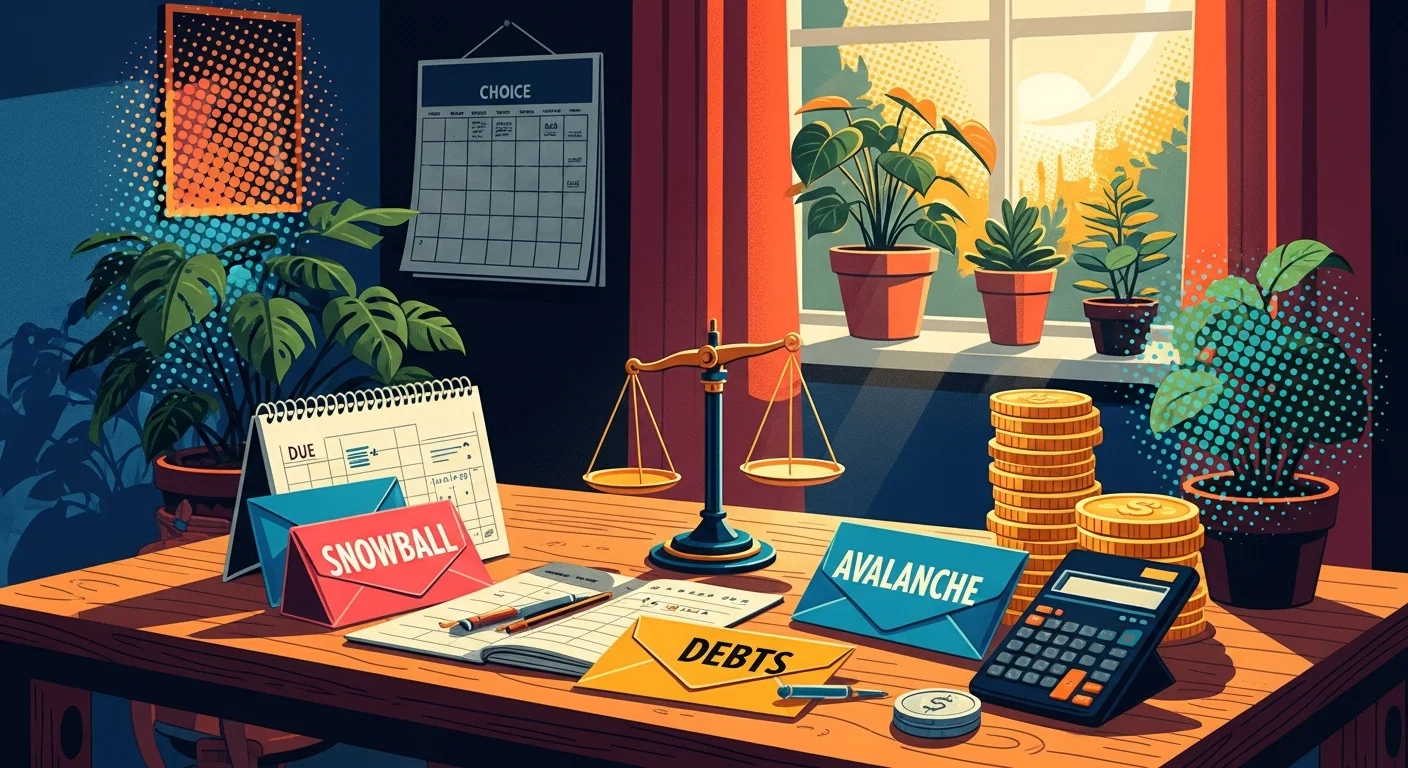
The debt avalanche method is simple: pay off your highest interest rate debt first. Make minimum payments on everything else, and throw every extra dollar at the debt costing you the most money. When that one's gone, roll the payment into the next highest rate. Repeat until you're debt-free.
It's the mathematically optimal way to eliminate debt. You'll pay less total interest and get out of debt faster than any other ordering — guaranteed. No tricks, no psychology hacks. Just math.
The trade-off? If your highest-rate debt also has the largest balance, you might go months without the satisfaction of crossing a debt off your list. That's where some people lose steam. But if you can stay the course, the avalanche saves you more money than any other approach.
What's your FI number? Calculate it in 60 seconds
The one number that changes everything
What Is the Debt Avalanche Method?
The debt avalanche method is a debt repayment strategy where you order all your debts from highest interest rate to lowest and focus extra payments on the highest-rate debt first. Once that debt is eliminated, you redirect its entire payment — minimum plus extra — to the next highest rate. The "avalanche" name comes from the way your payment power snowballs downhill, gathering force with each debt you eliminate.
This method minimizes the total interest you pay across all your debts. If you're the kind of person who'd rather save $800 than celebrate closing an account early, the avalanche is your strategy.
Compare snowball vs. avalanche
Find the fastest way to eliminate your debt.
Are You Leaving Money on the Table?
You could earn more per year with a high-yield savings account.
Compare Best HYSA RatesBased on 5.00% APY vs 0.45% national average. Rates vary.
FI Calculator
Travel Tools
Podcast
Local Groups
Forums
Book Club
Value Matrix
Debt Payoff
Workout Logger
Events
FI Calculator
Travel Tools
Podcast
Local Groups
Forums
Book Club
Value Matrix
Debt Payoff
Workout Logger
Events
FI Calculator
Travel Tools
Podcast
Local Groups
Forums
Book Club
Value Matrix
Debt Payoff
Workout Logger
Events
FI Calculator
Travel Tools
Podcast
Local Groups
Forums
Book Club
Value Matrix
Debt Payoff
Workout Logger
Events
Free Debt Payoff Planner
Compare snowball vs avalanche and see your debt-free date.
No password needed. Free forever.
How the Debt Avalanche Works: Step by Step
Step 1: List every debt with its interest rate. Write down the creditor, balance, APR, and minimum payment. Don't skip the small ones — a $200 medical bill at 0% still belongs on the list, just at the bottom.
Step 2: Sort by interest rate, highest first. This is your attack order. If two debts have the same rate, put the smaller balance first (it'll free up cash flow sooner at no extra cost).
Step 3: Pay minimums on everything. Every debt gets its minimum payment every month. Non-negotiable. Missing minimums triggers late fees, penalty rates, and credit score damage — all of which make your problem worse.
Step 4: Throw every extra dollar at the highest-rate debt. After all minimums are paid, every remaining dollar of your debt payoff budget goes to the top of the list. This is where the magic happens — each extra dollar reduces the balance that's generating the most daily interest.
Step 5: When the top debt is gone, roll everything to the next one. The minimum you were paying on the first debt plus all your extra payment now hits the second debt. Your payment power grows with each debt eliminated.
Free Debt Payoff Toolkit
Expense audit, payoff planner, and FI calculator — everything you need to crush debt and start building wealth.
Debt Avalanche Example With Real Numbers
Let's say you have $1,000 per month total for debt payments, and four debts:
- Credit card A: $6,500 balance, 26% APR, $130 minimum
- Credit card B: $2,800 balance, 22% APR, $56 minimum
- Personal loan: $5,000 balance, 12% APR, $150 minimum
- Car loan: $8,200 balance, 6% APR, $280 minimum
Total minimums: $616. That leaves $384/month in extra payment power.
Avalanche order (by interest rate):
- Months 1–13: Attack Credit Card A (26%). Paying $514/month ($130 min + $384 extra). Eliminated around month 13.
- Months 13–17: Roll to Credit Card B (22%). Now paying $570/month. Eliminated around month 17.
- Months 17–21: Roll to personal loan (12%). Now paying $720/month. Eliminated around month 21.
- Months 21–23: Roll to car loan (6%). Now paying $1,000/month. Done around month 23.
Total interest paid: approximately $3,200.
If you'd used the snowball method (paying off the $2,800 card first instead of the $6,500 card), you'd pay roughly $3,950 in total interest — about $750 more. Same debts, same monthly budget, but different ordering costs you an extra $750.
Your Student Loans Deserve a Custom Strategy
The average ChooseFI listener saves $24,000+ with an expert student loan plan.
Trusted by Brad Barrett, Co-founder and Host, ChooseFI
Debt Avalanche Pros and Cons
Pros
- Saves the most money. By attacking the highest rate first, you minimize the total interest paid across all debts. This is mathematically provable — no other ordering beats it.
- Gets you debt-free fastest. Less interest means more of each payment goes to principal. The total payoff timeline is shorter than snowball in most scenarios.
- Simple decision rule. No judgment calls needed. Just sort by APR and go. The math makes the decision for you.
- Best for high-rate debt. When you have credit cards at 20%+ alongside lower-rate loans, the avalanche advantage is at its largest.
Cons
- Slow first win. If your highest-rate debt is also your biggest balance, you might go many months before eliminating your first debt. That's psychologically tough.
- Requires discipline. Without early wins to celebrate, some people lose motivation and abandon the plan entirely. A plan you quit saves you nothing.
- Small advantage when rates are close. If all your debts are within a few percentage points of each other, the interest savings over snowball may be modest — maybe $100–200 total.
Who Should Use the Debt Avalanche?
The avalanche is the best fit when:
- You're motivated by math. If knowing you're saving the maximum amount of money keeps you going, even when progress feels slow, the avalanche is your strategy.
- You have wide rate spreads. A 24% credit card next to a 5% car loan? The avalanche advantage is huge. The wider the spread between your rates, the more money you save.
- All your debts are large. When there are no quick wins to capture — every debt will take months regardless — there's no psychological benefit from reordering. Go pure math.
- You're already committed. If motivation isn't your problem — maybe you've already had some wins or you're deep into the FI mindset — the avalanche rewards your discipline with maximum savings.
Not sure the pure avalanche is right? The hybrid debt payoff method captures a few quick wins first, then switches to avalanche order — giving you the best of both worlds.
How the Debt Avalanche Accelerates Financial Independence
Here's something most debt payoff articles miss: every dollar you save on interest is a dollar you can invest.
In the example above, the avalanche saved $750 compared to the snowball. That $750, invested in an index fund averaging 7% annual returns, grows to about $2,900 over 20 years. And that's just from one debt payoff cycle.
But the bigger win is the time saved. The avalanche gets you debt-free sooner, which means you start investing sooner. Even one extra month of investing — say $1,000/month — adds roughly $45,000 to your portfolio over 20 years at 7% returns. That's the compounding effect of getting out of debt faster.
Paying off a 24% credit card is a guaranteed 24% return on your money. No stock, bond, or real estate investment can promise that. The avalanche method ensures you capture that return as fast as possible.
Debt freedom is one of the key milestones on the path to financial independence. The avalanche is the fastest mathematical route to get there.
Common Mistakes With the Debt Avalanche
Ignoring predatory debt. If you have payday loans or title loans at 200%+ APR, the avalanche already tells you to pay them first — they're the highest rate. But some people don't realize how extreme these rates are. Check the APR, not just the fee amount.
Forgetting promotional rates expire. A 0% balance transfer card looks like it belongs at the bottom of your list. But if the promo rate expires in 12 months and jumps to 22%, you need to have it paid off by then — or it leapfrogs to near the top.
Skipping the employer match. Don't pause 401(k) contributions up to the employer match to pay debt faster. A 50% or 100% match is a guaranteed return that beats any interest rate. Contribute enough to get the full match, then avalanche everything else.
No emergency fund. Throwing every penny at debt without keeping at least $1,000–2,000 as a starter emergency fund means one car repair puts you right back on a credit card. Build a small buffer first, then avalanche.
Frequently Asked Questions
Does the debt avalanche really save money?
Yes. It's mathematically guaranteed to minimize total interest paid compared to any other ordering of the same debts with the same monthly payment. The savings depend on the spread between your interest rates and how long payoff takes — wider spreads and longer timelines mean bigger savings.
Is the debt avalanche better than the snowball?
Mathematically, always. Psychologically, it depends on the person. The avalanche saves more money, but the snowball method gives faster wins that keep some people motivated. Research shows people who close accounts early stick with their plans longer. If motivation is your bottleneck, consider the hybrid approach — quick wins first, then avalanche.
What if two debts have the same interest rate?
Pay off the one with the smaller balance first. When rates are identical, paying the smaller balance first frees up its minimum payment sooner, which gives you slightly more cash flow flexibility. The total interest paid is the same either way.
Should I use the avalanche for student loans?
If you have both federal and private student loans, the avalanche typically says to attack the private loans first (they usually carry higher rates and have fewer protections). For federal loans specifically, evaluate whether income-driven repayment plans or Public Service Loan Forgiveness change the math before committing to aggressive payoff. Our guide to paying off student loans fast covers this in detail.
How long does the debt avalanche take?
It depends entirely on your total debt and monthly payment power. A general rule: take your total debt, divide by your monthly extra payment, and that's a rough timeline in months. The avalanche will be slightly faster than this estimate because as debts are eliminated, less of your payment goes to interest. Use our how to pay off debt framework to map your complete plan.
Related Reading
Compare Snowball vs. Avalanche
Find the fastest strategy to eliminate your debt and free up cash flow.
Build Your Plan