
Key Takeaways
- The ACA marketplace is the primary option for self-employed and early retirees — premium subsidies are based on modified adjusted gross income (MAGI), making them highly favorable for those who control their taxable income.
- COBRA provides a temporary bridge (up to 18 months) after leaving employer coverage, but premiums are typically expensive since you pay the full cost plus a 2% admin fee.
- Health sharing ministries are a lower-cost alternative, but they are not insurance — they have sharing guidelines, not coverage guarantees, and may not cover pre-existing conditions.
- An HSA paired with a high-deductible health plan is one of the most powerful FI tools — triple tax advantage and the ability to invest for decades of tax-free growth.
Health Insurance by the Numbers
Whether you're self-employed or early retired, one of the biggest challenges you face is getting health insurance. Many employees have the benefit of an employer-subsidized health insurance plan. That's almost always the best deal possible. As an employee, you may pay $400 per month on the plan which costs $1,000, with the balance being covered by your employer.
Since the rollout of the Affordable Care Act, the only health insurance plans available to individuals are in the individual state health insurance exchanges. If you've done any investigating on those sites, you're painfully aware of how expensive private health insurance can be.
But are there alternative sources for health insurance that might offer less expensive options when you're self-employed or early retired?
As much as we'd like to say we've found the hidden treasure trove of inexpensive health insurance, we can't. But we can point you in the direction of several sources of options that might enable you to obtain more affordable health insurance.
As you read through these options, please keep in mind there are no perfect health insurance plans out there, at least not one you can buy on the cheap. As well, some of the non-profits listed below don't give a whole lot of information about their plans. In many cases, they request information so that you can be contacted by a licensed health insurance agent.
There's no way to know exactly how that will play out, but if you're searching for different health insurance options, each may be worth a try.
The Writer’s Guild Of America
I'm including this one at the top of the list, because it's probably the most frequently cited health insurance source, at least for bloggers. The connection of course isn't far-fetched, since blogging is a form of writing.
At the same time, I’m also hoping to put to rest the assumption that it extends to bloggers. The official name of the benefits plan is the Writers’ Guild of America Theatrical and Television Minimum Basic Agreement. That should be a clue.
Research into this plan provided the following insights:
- To be eligible, your writing activity must be in the theatrical and television industries. It’s very specific.
- You are only eligible to participate if your employer sponsors the plan, and also makes contributions on your behalf.
- A call to the organization confirmed that bloggers are not eligible to be members of the Guild or to participate in the health program.
So there you have it. If this source shows up on any lists in the future, and you're hoping to qualify as a blogger, just ignore it and move on. There's no health insurance to be had here.
Find Your FI Number
See where you stand and model your path to financial independence with our free calculator.

You're in!
Check your email to get started with your FI Number.
Affiliated Workers Association
The Affiliated Workers Association; is an organization established to provide benefits and resources to its members. Membership includes entrepreneurs, self-employed professionals, small business owners, and independent contractors, all of whom must be at least 18 years of age. Eligibility is available in all 50 states.
Unfortunately, the Association does not offer a full-blown health insurance policy to its members. Instead, they provide short-term medical, which provides benefits for terms of one, two, or three months, less one day. Because they are short-term plans, they’ll work best as interim coverage.
You have to contact the association to get premium rates.
If short-term coverage will work for you, the plan covers doctor visits, hospital confinement, emergency room visits, surgery, anesthesia, urgent care, nursing and home health facilities, mental health, physical health, and even transplant benefits. Services are available through the Preferred Provider Organization (PPO) network through Aetna.
Be careful with short-term medical plans though. They generally don’t cover pre-existing conditions.
In addition to short-term medical coverage, the association also offers accidental insurance, dental insurance, and prescription and vision insurance.
How to Choose Health Insurance After Leaving Your Job
A step-by-step framework for self-employed individuals and early retirees navigating health coverage options.
Estimate your modified adjusted gross income (MAGI)
Your MAGI determines your ACA subsidy eligibility and amount. For early retirees, this is often much lower than your working income since you are living off savings and investments. Roth conversions, capital gains, and rental income all count — plan your income strategically to maximize subsidies.
Pro tip: Keep your MAGI below 400% of the federal poverty level for your household size to qualify for premium tax credits. For a family of 4 in 2026, that is roughly $120,000.
Shop the ACA marketplace during open enrollment
Visit healthcare.gov (or your state marketplace) during open enrollment (November 1 - January 15). Compare Bronze, Silver, Gold, and Platinum tiers. Silver plans unlock cost-sharing reductions at lower income levels. Bronze plans with an HSA are popular in the FI community for their lower premiums and investment potential.
Pro tip: If your MAGI is between 100-250% of the federal poverty level, choose a Silver plan to access cost-sharing reductions that lower deductibles and copays — savings that do not apply to other tiers.
Evaluate COBRA as a short-term bridge
COBRA lets you keep your employer plan for up to 18 months after leaving, but you pay the full premium (employer + employee share) plus a 2% admin fee. This can mean $1,500-$2,500/month for a family. It is most useful as a bridge when you leave your job mid-year and need coverage until the next ACA open enrollment.
Pro tip: You have 60 days to elect COBRA retroactively. If you stay healthy during that window, you can skip COBRA and enroll in ACA instead — saving months of premiums.
Consider a health sharing ministry
Organizations like Medishare, Liberty HealthShare, and Samaritan Ministries offer monthly shares of $200-$500 per family. They are not insurance — members share medical costs according to guidelines. They often exclude pre-existing conditions and may have lifestyle requirements. Best suited for healthy families comfortable with some risk.
Pro tip: Read the sharing guidelines carefully. Health sharing ministries are not regulated like insurance, and there is no legal guarantee your bills will be shared. They work best as a supplement to a strong emergency fund.
Pair your plan with an HSA strategy
If you choose a high-deductible health plan (HDHP) through the ACA or COBRA, you qualify for an HSA. Max out contributions ($4,400 individual / $8,750 family in 2026), invest in low-cost index funds, and pay medical expenses out of pocket. The triple tax advantage makes this one of the best wealth-building tools available.
Pro tip: Open your HSA at Fidelity for zero fees and full brokerage investment options. Save every medical receipt — there is no deadline for tax-free reimbursement.
Find your FI number in 60 seconds
Free calculator shows when you could reach financial independence — plus a savings rate tracker, expense audit, and more.
Associated for Computing Machinery
Associated Computing Machinery is a trade organization established for computer professionals, which is a good thing since so many computer professionals are either self-employed or work on a contract basis.
They offer short-term medical, dental insurance, accidental death and dismemberment, long-term care, and disability income plans.
But the plan of greatest interest is their major medical. The plan is available through Healthinsurance.com and Mercer Consumer, which provide online medical insurance quotes.
Depending on your state of residence, you may be eligible for either a PPO or HMO. They also have medical spending accounts available, as well as fee-for-service plans. Coverage is available for you and your eligible family members. If you are a business owner you can also qualify for a group plan for both you and your employees.
The plan typically does not require a medical exam, but for certain plans, you may need to provide evidence of good health. You can get a health insurance quote either by applying online or by calling a licensed insurance agent.
Build Your FI Plan
Map your path to financial independence with personalized calculators and milestone tracking.
- Save your progress
- Get personalized next steps
- Access calculators and resources
You're in!
Check your email to get started with your FI Plan.
The Freelancer's Union
Freelancer’s Union takes in more than 375,000 members, representing the 57 million independent workers across the country. Membership is free and open to all types of freelancers, including moonlighters.
The organization does offer health insurance, as well as term life, disability, liability, and dental insurance.
On the health insurance side, they do direct you to Healthcare.gov. But they also have PPO plans through both Cigna and Emblem Health. Each plan provides both in-network and out-of-network coverage.
To qualify, you have to be an independent contractor or small business owner. You can also include your employees in the coverage if you have any. You must also have a minimum income of $1,950 per month, as well as an employer identification number for your business.
Now here's the bad news: The coverage is available only if you are located in New York, New Jersey, Connecticut, or Pennsylvania.
You also have to hire a Professional Employer Organization (PEO) acting as an outsourced human resources department and then set up a monthly payroll.
They warned that the PPO coverage may be more expensive than what's available on the individual market, which looks as if the plans involve setting up employer group plans. If so, this coverage might work best if you're a small business that has employees to help share the cost.
Related: Choosing Your Health Insurance: A Guide For Open Enrollment
National Association for the Self-Employed
The National Association for the Self-Employed, or NASE, was formed in 1981 to provide support, access to experts, benefits, and consolidated buying power for the self-employed. It claims to be the largest nonprofit, nonpartisan association of its kind in the US.
The information looks promising, but you're directed to provide information so that you will be contacted by a licensed insurance agent.
You Might Also Like
Use one of these tools to figure out your next FI step.
Alliance for Affordable Services
The Alliance for Affordable Services; is another non-profit organization representing thousands of small business owners and individuals nationwide. They provide various types of benefits including accidental death, a prescription card, a dental discount plan, life insurance, and mail service pharmacy.
They offer health insurance, or more precisely access to health insurance, but provide little information as to exactly what's offered. Instead, they say they can have a licensed professional insurance agent contact you about available options in your state.
Now let's move beyond non-profit associations that offer health insurance, to some more hands-on options.
ACA Plan + HSA or Dedicated Emergency Fund
Here you return to the Affordable Care Act plans, which is also just where you may end up if you apply for coverage through any of the non-profits above. But if you do it right, you may be able to get an ACA plan that's a lot less expensive than you think.
- If your income is low enough, which may be the case if you are early retired, you may be entitled to a tax credit that significantly reduces the cost of your premiums.
- If you're self-employed, the cost of health insurance premiums is tax-deductible, at least for federal income tax purposes.
- You can deduct the cost of the premiums even if you don't itemize, and coverage can include your family.
But still, another option is to take a plan on the health insurance exchanges--one with a high deductible to minimize the cost--then add either a health savings account (HSA) or an emergency fund to cover it.
The HSA has the added benefit of also being tax deductible, even if you don’t itemize. For 2023, you can put as much as $4,400 if you’re an individual, or $8,750 if you’re a family, into the plan. Alternatively, you can use an emergency fund for the same purpose. The money you put into the account isn't tax deductible, but if you don't use it for health care purposes, it'll be available for anything else, you want to do with it.
An ACA/HSA/Emergency Fund Example
You can check out plans and premiums on HealthCare.gov’s Health Insurance Plans and Prices page. The Official enrollment runs from November 1st to December 15th, but you can go on this site and run numbers anytime.
Let's say you are a married couple, each 40 years old, with 2 children, living in Charlotte, NC, and earning $100,000 per year.
If you take their plan with no deductible, your monthly premium will be $849.33. But if you take a plan with a $2,000 deductible, the monthly payment drops to $666.37.
But you can take the plan with the lower premium, and cover most of the deductible with a $8,750 contribution to an HSA account. And if you're 'self-employed, you get tax deductions for both. Whatever funds you have in the HSA that have not been spent, can simply stay in the account and can be used in future years.
You can do the same thing with an emergency fund, using it to cover the deductible. Alternatively, let's say you decide to take a plan with a deductible of $10,000. You could put $8,750 into the HSA, and another $2,250 into the emergency fund.
None of these options are cheap, but they can be tax deductible, and you will retain any money in either the HSA or the emergency fund that isn't spent.
Where Is Your Money Going?
Our free Expense Audit tool breaks down your spending by category and reveals exactly where you can save more. Create a free account to start.
- Category-by-category spending breakdown with visual charts
- Savings potential analysis — see where you can cut without pain
- Track spending month over month and celebrate wins
Free forever — no credit card required
Monthly Spending
$4,180
Potential savings: $620/mo identified
Spending by Category
$4,180
Spending
$620
Can Save
$7,440
Per Year
Preview — create free account to use
Part-time Jobs with Health Insurance
On the surface, this may not seem like a perfect solution either (but remember, we said there aren’t any!). But if you're self-employed, you're probably familiar with the concept of maintaining multiple income sources. By making one of them a part-time job, you might also be able to get health insurance at the same time. And though it runs counter to the whole idea of early retirement, you might look into one of these job situations if you're getting bored, and looking for a little something to do on the side.
Most everyone has heard of Starbucks in connection with part-time jobs offering health insurance. But you may be surprised to learn the diversity of employers providing it. The list includes banks and credit unions, hospitals, county, and municipal governments, colleges and universities, airlines, and a wider variety of retailers than you might imagine.
At a minimum, a part-time job with health insurance may provide a valuable bridge between other options. One might be where you retire at 62, and won’t be eligible for Medicare until you’re 65.
Car Insurance: Complete Guide to Coverage, Costs, and Savings
Continue exploring this topic with our in-depth guide.
Christian Health Sharing Ministries
These aren't health insurance policies in the traditional sense, but rather plans in which people pool their money together through monthly contributions, to pay the medical expenses of participating individuals. That's basically health insurance, but the setup is a lot less formal.
However, the plans are fully ACA compliant and work much the same way as traditional insurance.
Four examples of Christian health-sharing ministries include:
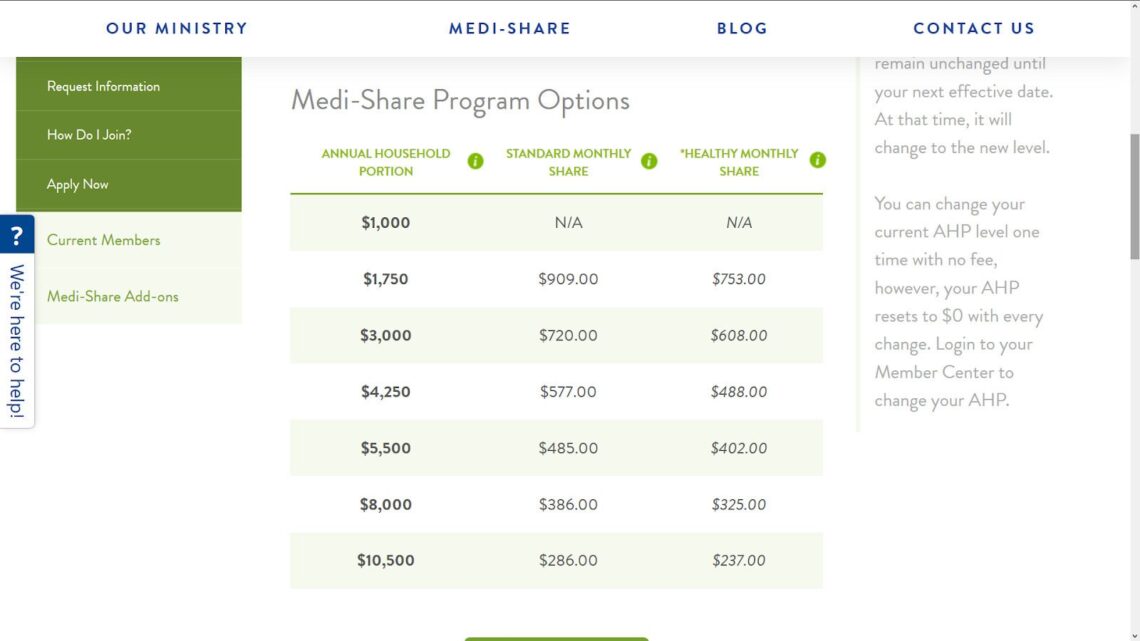
The big advantage of these plans is that they cost considerably less than traditional health insurance. In the screenshot below, we see the cost of a policy for a family headed by an individual at age 40.
The “Annual Household Portion” is the deductible, while the “Standard Monthly Share” is the payment. (“Healthy Monthly Share” applies if you meet certain health criteria.)
As you can see, the monthly contribution for family coverage with a $3,000 deductible--which is quite reasonable by today's standards--is $720. That's substantially less than the premium amounts on the ACA policies we pulled up above for a couple with no children and much higher deductibles.
 Christian health-sharing ministries, however, are not without their limitations. As the name implies, you must be a Christian to qualify. Some have very specific requirements in that regard,
that would even exclude casual Christians.
Christian health-sharing ministries, however, are not without their limitations. As the name implies, you must be a Christian to qualify. Some have very specific requirements in that regard,
that would even exclude casual Christians.
You also may not be accepted into the plan if you have a pre-existing condition, like diabetes or heart disease. However, some do offer an up-charge on the monthly contribution if you have a pre-existing condition.
Final Thoughts on Getting Health Insurance When You’re Self-Employed or Early Retired
You're probably tired of hearing it, but it's worth repeating: there are no secret inexpensive health insurance options available anymore. If you aren’t covered by an employer plan, any plan you take will be a compromise in some direction. But the options we've provided above will at least give you an opportunity to do a thorough search of what might be available for you.
Investigate each, and see if you can find a plan that works for you.
Related Articles
Start Your FI Journey Today
Free calculators, a personalized FI roadmap, and a community of 25K+ on the same journey.
Create a free account to get started
You May Also Like
Frequently Asked Questions
Yes. The ACA marketplace is open to anyone regardless of employment status. Self-employed individuals can deduct 100% of their marketplace premiums on their tax return (Form 1040, line 16), and premium tax credits are based on your projected annual income.
The ACA marketplace is the most common option for early retirees. You can also use COBRA for up to 18 months after leaving your employer, explore health sharing ministries, or consider short-term health plans as a temporary bridge. Medicare eligibility begins at 65.
There is no longer a hard income cutoff. Under the enhanced ACA rules, premium subsidies are available at all income levels — no household pays more than 8.5% of income for the benchmark Silver plan. However, subsidies are most generous below 250% of the federal poverty level.
No. Health sharing ministries are not insurance and are not regulated by state insurance departments. Members voluntarily share medical costs according to the organization guidelines. There is no legal guarantee of payment, and many exclude pre-existing conditions, mental health, and preventive care.
Yes, if your ACA plan qualifies as a high-deductible health plan (HDHP). Look for Bronze or Silver plans with deductibles above the HDHP threshold ($1,650 individual / $3,300 family in 2026). Many Bronze plans on the marketplace qualify.
Compare costs carefully. COBRA preserves your exact employer plan but you pay the full premium (often $1,500-$2,500/month for families). ACA plans may be cheaper, especially with subsidies. Leaving your job is a qualifying life event that lets you enroll in ACA coverage outside open enrollment.
The Bottom Line
Health insurance is one of the biggest concerns for anyone leaving traditional employment, but it should not be the reason you stay in a job you want to leave. The ACA marketplace provides subsidized coverage for self-employed individuals and early retirees at every income level. By managing your MAGI strategically, pairing a high-deductible plan with an HSA, and planning your coverage transitions carefully, you can maintain excellent health coverage at a fraction of what your employer was paying. The FI community has proven that health insurance is a solvable problem — not a barrier to financial freedom.
ACA marketplace coverage options
4 tiers
Max premium as % of income
8.5%
HSA family limit (2026)
$8,750