ChooseFI

You're in — welcome to ChooseFI!

Keep an eye on your inbox over the next couple of weeks. We're going to send you the best of what we've built over the last 10 years — curated to help you wherever you are on your financial journey. The more you engage, the better we can tailor what we send to exactly what you need.

592: Value Matrix Case Study: Leaky Budget

Podcast

Ep. 592 Value Matrix Case Study: Leaky Budget

Unlock financial clarity with the Value Matrix and align your expenses with personal values for a life that matters.

Jonathan Mendonsa, Brad Barrett · · 35,474 plays
51m 5s
  1. Introduction to the Value Matrix
  2. Case Studies Overview
  3. Community Growth
  4. Leaky Budget Case Study

Choose FI has partnered with CardRatings for our coverage of credit card products. Choose FI and CardRatings may earn compensation from card issuers when a customer clicks on a link, when an application is approved, or when an account is opened. Opinions, reviews, analyses & recommendations are the author's alone, and have not been reviewed, endorsed or approved by any of these entities. American Express is a ChooseFI advertiser.

Jonathan and Brad introduce the Value Matrix, a tool that maps spending to life satisfaction. They analyze four real spending profiles to show how different approaches can affect financial independence. Learn how aligning expenses with personal values can transform your financial journey.

Key Topics Discussed

  • Introduction to the Value Matrix
  • Overview of four diverse spending profiles
  • Expansion of Choose FI community groups
  • Analysis of a leaky budget case study

Timestamps

  • 00:00:00 - Introduction to the Value Matrix
  • 00:03:00 - Case Studies Overview
  • 00:10:00 - Community Growth
  • 00:17:00 - Leaky Budget Case Study

Key Takeaways

  • Evaluate your expenses using the Value Matrix.
  • Identify and eliminate unnecessary leaks in your budget.

Resources

Speakers

  • Jonathan Mendonsa
  • Brad Barrett

Top Travel Card

Ready to unlock a world of free travel? Start with the Chase Sapphire Preferred® Card

$95 annual fee | Earn 75,000 bonus points

Best Card for Side Hustlers and Business Owners

Side hustlers! With the Ink Business Preferred® Credit Card you can earn free travel from your business expenses.

$95 annual fee | Earn 100,000 bonus points

Most Flexible Travel Card

The Capital One Venture Rewards Credit Card can be used to offset almost any travel expense.

$95 annual fee | 75,000 Miles once you spend $4,000 on purchases within 3 months from account opening

ChooseFI has partnered with CardRatings for our coverage of credit card products. ChooseFI and CardRatings may receive a commission from card issuers.

Read Transcript

Join the Conversation

14 comments on this episode. Create a free account to share your thoughts.

Comments (11)

Your comment will be posted after signing in
McLovin 2 weeks ago

Adding a comment about the life insurance topic briefly touched on in this episode at minute 25. When talking about whether term life insurance is needed and you are in a partnership or family, I think important points to consider are:

1) was your social security part of the calculations and what happens if that's removed?

2) Will expenses for your partner/family increase after your death? Can the plan handle that? For example, if I die my wife would probably need to hire landscapers, handyman, more childcare help, etc. Things are not part of the current expenses. If minor children involved, there are survivor benefits that may cover this, but something to consider.

3) In the episode, an untimely death was phrased as something instant. But what if it's a prolonged illness that will take extra money until you die? Cancer treatments not covered by insurance, hiring in-home care, modifying a residence after a stroke, etc. These are hopefully rare things but a term life insurance could pass the sleep-well-at-night test. It probably doesn't need to be a big policy either.

MaryBeth 3 weeks ago

I'd love for there to be an option to increase a category too. I know that might be controversial. But, for example, I found I'm spending $25 a month on fun outings with my niece. I'd like to up that to $100 and do even more fun things (and I will). It would be nice to be able to reflect that.

mdhershberger32 3 weeks ago

Thanks for the encouragement to take a closer look at our expenses! I haven’t actually worked through the expense audit or value matrix yet but knew I could start working on some of the “high cost/low value” items that immediately came to mind. I used the online chat feature for our auto insurance and 5 minutes later, locked in $500 of annual savings just by having them rerate us. I’m working on our phone and internet plans now and should be able to save over $750 per year between those. Such a worthwhile investment!

Kateryna Yuri 3 weeks ago

Thank you for the nudges with the expense audit and the value matrix! And also thank you for the reminder to get off the sofa and do something FI-centric. After doing the expense audit and value matrix exercise here, I also ran my expense audit through Chat GPT as well and got a few more suggestions. For the actions, I went ahead and cancelled some subscriptions (YouTube, which I thought I needed, web hosting which I don’t really use, and Dropbox, which I had since the days of a smaller hard drive laptop, which I replaced a year ago). I also did a round of shopping my closet for some professional attire for a new job that I am starting soon, and put some reminders in my expenses spreadsheet for spending limits on some of my categories, like clothes and beauty expenses. I also set a task in Chat GPT to send me daily reminders on “you don’t need another XYZ” to help me stay on track and motivated.

2
LisaB 3 weeks ago

I found this to be a useful exercise and was proud that I had all of my expenses at hand (and they fit into the categories, so I likely captured most of them), but I’m having trouble interpreting the final recommendations to trim/cut. For instance, it was recommended a cut $400 from my ‘miscellaneous’ category and $60 from my ‘personal’ one - but it doesn’t seem to break down exactly what in each of those categories to trim/cut. Each of those categories is made up of several expenses that are all over the place on the joy matrix - so it would be helpful to know if the recommendations are for specific expenses or just for the entire category (and I guess I choose which expenses to cut/trim?). Anyone wondered about this?

Thanks for any insight,

Lisa

1
JoeQ17 3 weeks ago

Great work and episode on value matrix, as you noted, the expense audit is just a steppingstone to this necessary action.



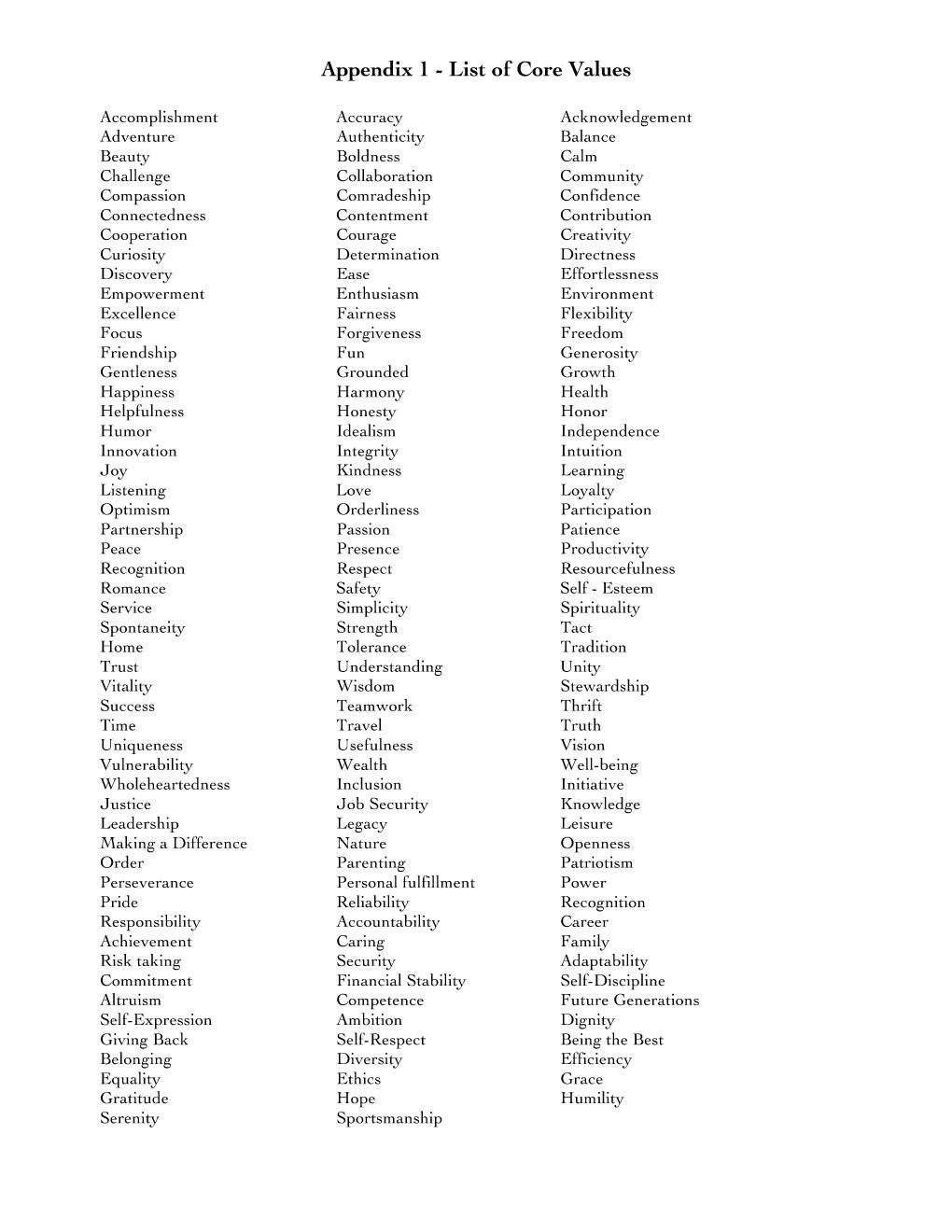
One question I would challenge us all to ask ourselves, do you truly know what you value? For those that have never done one, would highly suggest a value exercise. Attached is one example (plenty on the web), run through the list and wind down to your top 5-7 values (and do same with rest of the family). Then look back at your expenses to see if they truly match supporting your values.

Tying to this, for those in a relationship, highly suggest taking the Five Love Languages test (for spouses and kids) and reading the book. You may wonder, what does that have to do with expenses? Through this exercise learned that my wife most appreciates love through shared time and talking a 20min walk was more powerful and cheaper than buying flowers.

These two exercises helped our family come closer and when we were accumulating allowed us to cut expensive gifts and things we didn't value so that now we're able to maximize our spend on those shared experiences that bring us love and value.

3 2
Nicole Ingram 4 weeks ago

What a fun and engaging episode! We use a similar priority matrix at work to prioritize performance improvement initiatives - so this really hit home for me with the matrix curated to meet FI mindset!

I need to do my own expense audit so I feel like a hypocrite recommending this. I know the couple put audiobooks/books at high value / low cost with $40/month spending but I was surprised to hear that Libby (or any of the other free apps) didn’t come up as an alternate. This is one of my best frugal wins over the last 2 years! I don’t pay for audiobooks anymore, I use my community resource (digital library card), and I reduce the amount of things in my home as a result. Win-win! If that is an option for them, that could be an easy $480 back in their pocket annually.

2 2
JessBuildingThings 4 weeks ago

Is the value matrix link somewhere that I'm missing? I don't see it listed at the top of "Related Links". Love this tool to evaluate whether we're living into what Ramit Sethi would consider our "Rich Life" or not!

Jonathan Mendonsa 4 weeks ago

Go to tools on the more menu (mobile) or tools and resources on desktop left menu

1
Lottie Payne 4 weeks ago

Loved this episode, thanks guys. We completed an expense audit as a result. I called a few suppliers to negotiate costs down and we made a conscious choice to cut some things we were spending on that weren't in line with our values. Net result, we ended up saving an additional £250/mo, or £3,000/year, which has gone straight into investments. On Brad's math, that's a positive £225,000 swing in the right direction (based on a $90,000 gain per £100/mo you cut from your expenses).

1
Skyler Fleming 4 weeks ago (edited)

Thank you guys for this martrix! This is a great lens to look at spending through and while the savings now can seem small. The value really hit home with the impact on the FI number at the end!

On the note of meal planning, my wife and I have been building a system around meal planning for 4 years. We've got it to the point now where we're spending <$400 per month between groceries and eating out. I'd love to share it with you guys if you want to learn more. Lots of little ideas for other people to take from our system that would help them out.

8 1
BPinVA 4 weeks ago

I would love to learn about this!!

1
mdhershberger32 4 weeks ago

Hey Skyler! Does your groceries line item only include food or other household items as well? That’s one thing I’ve been struggling with thinking through the expense audit - should I be going through every individual receipt to separate out food vs. other items? $400 per month sounds fantastic though - congrats!

1
mehotrt 4 weeks ago

Looking forward to using the "Matrix" this week. It was nice to hear someone else's spending sound close to my own. A reminder I am not special and there are small cuts that can lead to big savings.

3
Join the Conversation

Create an account or sign in to post a comment.

Username
Email

No password needed. We'll send a verification email.

Email
Password
Welcome back, !

Enable commenting on this device so you can post without signing in each time.

You can turn this off anytime

Get Brad's weekly FI strategies — free

Join ChooseFI

Start your financial independence journey

  • Access to the ChooseFI community
  • Exclusive FI resources and tools
  • Weekly actionable insights
or

Already have an account? Log in

Try searching for

⌘K to open anytime

Your FI Journey

1/3

Step 1 of 3

How familiar are you with Financial Independence?