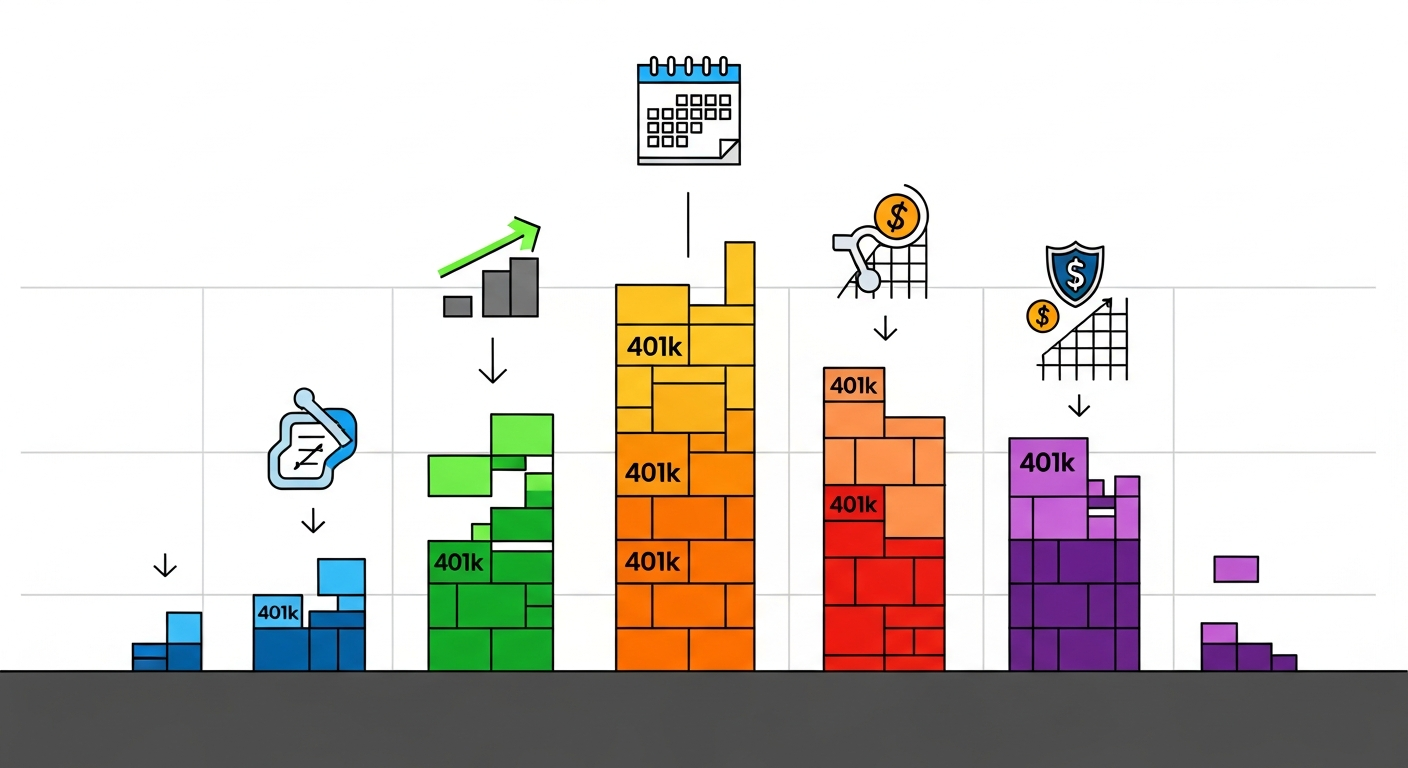
Key Takeaways
- The median 401(k) balance at 45–54 is $60,763 — far below what's needed for traditional retirement, let alone early FI.
- Averages are misleading: wealth concentration at the top inflates them 2–4× above the median in every age bracket.
- FI-adjusted targets are dramatically higher than conventional benchmarks — a 35-year-old targeting retirement at 50 needs ~$480K, not the $100K national median.
- Coast FI is the escape hatch: once your portfolio hits the Coast FI number, compound growth handles the rest.
What's your FI number? Calculate it in 60 seconds
The one number that changes everything
The numbers most Americans don't want to see
Average and median 401(k) balances tell very different stories. The median is what actually matters.
Average and Median 401(k) Balances by Age Group
The table below draws from Vanguard's How America Saves report and supplemental Fidelity data — the two most comprehensive sources available on U.S. retirement account balances.
Data last updated: Vanguard "How America Saves" 2024 edition (reflecting 2023 plan year data); supplemental figures from Fidelity Q4 2023 retirement trends report.
What these numbers mean, age by age:
- Under 25: Small balances are expected — most workers in this group are just getting started. Even $2,800 in the account matters because of compound growth over 40+ years.
- 25–34: The median drops to $14,933, which reflects career changes, student debt, and inconsistent participation. This is the decade where consistent contributions create an outsized long-term impact.
- 35–44: A big gap opens between average ($97k) and median ($36k). Many households are balancing mortgages, childcare costs, and retirement simultaneously. The median tells the real story here.
- 45–54: Median savers have $60,763 — still well short of most retirement targets. Catch-up contributions (currently $7,500 extra per year for those 50+) become available at 50 and make a meaningful difference.
- 55–64: This is the final stretch before traditional retirement age. A median balance of $89,716 would generate roughly $3,500–$4,500 annually using a 4% withdrawal rate — far below what most households need.
- 65+: Average and median converge slightly, but $88,488 in median savings remains a serious shortfall for funding a 20–30 year retirement without Social Security filling a large portion of the gap.
Why the Median Matters More Than the Average
Averages are easy to calculate and easy to misread. Here's a concrete example: imagine 9 people each have $50,000 saved in their 401(k), and one person has $5 million. The average balance across all 10 people is $545,000 — a number that doesn't reflect the reality of a single person in that group.
That dynamic plays out at scale in U.S. retirement data. Wealth concentration at the top skews 401(k) averages upward by 2–4x compared to the median in most age brackets. A 45-year-old comparing themselves to the $179,200 average might feel reasonably on track — but the median for their age group is $60,763.
The median tells you what a typical person your age has actually saved. That's the number worth benchmarking against. We're showing you both figures precisely because the average, while commonly cited, can create a false sense of where most people actually stand.
When you see your own balance and want to know how it compares, look at the median column first.
What These Numbers Tell Us — And What They Don't
The data is sobering. Across nearly every age group, median balances fall well short of what traditional retirement planning guidelines recommend — and those guidelines assume a retirement starting at 65, not 50 or 55.
If your goal is financial independence before traditional retirement age, these benchmarks don't apply to you directly. A 40-year-old targeting FI at 50 needs a fundamentally different savings rate and target balance than someone planning to work until 65.
Think of the averages and medians above as a baseline — useful context for where most Americans stand, but not a template for building a life on your own terms. The next question worth asking: what should you have at each age if FI is the actual goal?
Average and Median 401(k) Balances by Age
Data from Vanguard's How America Saves report
| Age Group | Average | Median | Avg. Rate |
|---|---|---|---|
Notice the average is 2–3× the median at every age. A few large balances pull the average up significantly.
Where Is Your Money Going?
Our free Expense Audit tool breaks down your spending by category and reveals exactly where you can save more. Create a free account to start.
- Category-by-category spending breakdown with visual charts
- Savings potential analysis — see where you can cut without pain
- Track spending month over month and celebrate wins
Free forever — no credit card required
Monthly Spending
$4,180
Potential savings: $620/mo identified
Spending by Category
$4,180
Spending
$620
Can Save
$7,440
Per Year
Preview — create free account to use
Median 401(k) balance by age group
The median tells a more honest story. Half of all 55–64 year olds have less than $90K in their 401(k) heading into retirement.
Start Your FI Journey Today
Free calculators, a personalized FI roadmap, and a community of 25K+ on the same journey.
Create a free account to get started
The FI-Adjusted Benchmarks: What You Actually Need
The national averages we covered earlier describe where most Americans are. This section describes where you need to be — and the gap between those two things is where the real work happens.
First, Know Your FI Number
Before any benchmark makes sense, you need a personal target. That starts with your FI number: the total investable assets required to support your lifestyle indefinitely without working.
The math is straightforward:
FI Number = Annual Expenses × 25
This comes from the 4% safe withdrawal rate — the research-backed principle that a diversified portfolio can sustain annual withdrawals of 4% over a 30+ year retirement. Multiply your annual spending by 25 and you have the portfolio size that makes that math work.
Quick examples:
- Spending $40,000/year → FI number of $1,000,000
- Spending $60,000/year → FI number of $1,500,000
- Spending $80,000/year → FI number of $2,000,000
One critical framing point: your 401(k) is one bucket contributing to this number — not the only one. Total investable assets across your 401(k), IRA, Roth IRA, taxable brokerage accounts, and HSA all count. The national benchmarks you read about in financial headlines typically track 401(k) balances in isolation, which is why they feel both alarming and incomplete at the same time.
For the full methodology and a walkthrough tailored to your situation, see our guide: How To Calculate Your FI Number.
FI-Adjusted Target Balances by Age
The table below replaces generic industry benchmarks with targets calibrated to actual early retirement timelines. Assumptions: 7% real annual return, $50,000 in annual expenses, FI number of $1,250,000, all investable assets included (not just 401(k) balances).
*Savings rate estimates assume starting from $0 at age 22 with income growth. Your actual rate will vary based on starting balance, income, and expenses.
The gap column is the point. At age 35, the median 401(k) holder sits at roughly $100,000. Someone targeting retirement at 50 needs to be at $480,000 — a $380,000 difference. That gap isn't a condemnation; it's a signal. It tells you exactly how much the conventional savings pace undershoots an early retirement goal, and it makes clear that savings rate is the most powerful lever available to you.
To calculate your current savings rate and see how it maps to your timeline, visit: How To Calculate Your Savings Rate.
Coast FI: When Your 401(k) Can Run on Autopilot
Coast FI is a milestone that often gets overlooked — and it's one of the most motivating numbers you can calculate.
Here's the definition: Coast FI is the portfolio balance at which compound growth alone — with no additional contributions — will grow to your full FI number by your target retirement age. Once you hit Coast FI, you only need to cover your current living expenses. You don't need to save another dollar toward retirement.
The formula:
Coast FI Number = FI Number ÷ (1.07)^(Years Until Retirement)
Worked example: You're 35, targeting retirement at 60, and your FI number is $1,250,000.
- Years until retirement: 25
- (1.07)^25 ≈ 5.43
- Coast FI number: $1,250,000 ÷ 5.43 ≈ $230,000
If you have $230,000 invested at 35 and never contribute another dollar, a 7% real return gets you to $1.25M by age 60. That's Coast FI.
Coast FI targets by current age (assuming 7% real return, $1,250,000 FI number):
Why this milestone changes things: Once you reach Coast FI, your financial pressure fundamentally shifts. You no longer need a high-income job to stay on track. That opens real doors — a lower-stress role, a career pivot, starting a business, or moving into Barista FI (part-time work that covers current expenses while your investments compound untouched).
The ChooseFI podcast has featured dozens of community members who hit Coast FI in their 30s and used it as the catalyst to restructure their work lives entirely — not by retiring immediately, but by choosing work on their own terms. Episodes like #105 ("Coast FI Deep Dive") and community stories shared on episodes #210 and #318 illustrate how this milestone shows up differently for different households, but consistently produces the same result: reduced anxiety and increased optionality.
If the national median 401(k) balance by age tells you where most people are, Coast FI tells you the minimum you need to reach before the math starts doing the heavy lifting for you.
FI-Adjusted Benchmarks vs. National Medians
What you actually need to retire early — not just 'on time'
| Age | National Median | Retire at 50 | Retire at 45 |
|---|---|---|---|
FI targets assume $60,000 annual spending and 7% real returns. The gap column shows how far the typical American is from early retirement.
Insurance in Ohio
Coverage guides and savings tips for your state.
Your 401(k) by Decade: Benchmarks and FI Strategy
The average 401(k) balance by age tells one story. What you do with that information is a completely different one. Whether you're just starting out or running the numbers at 52, here's how to think about where you stand — and what to do next.
In Your 20s: The Foundation Decade
If your 401(k) balance feels embarrassingly small right now, you're in good company. The national median 401(k) balance for adults under 25 is typically under $7,000, and for the 25–34 bracket it sits around $20,000–$30,000. That's not a failure — it's the starting line.
The FI strategy in your 20s is straightforward: capture the full employer match first. If your employer matches 50% of contributions up to 6% of your salary, that's a guaranteed 50% return on that portion of your money before the market does anything. No investment reliably beats that. Read more in What to Know About Your 401(k) Match.
Once you've locked in the match, focus on building the savings habit itself. Automate your contributions, increase them with every raise, and aim for a 15%+ savings rate to start — including any employer match — with a goal of hitting 20%+ before your 30th birthday.
The math here is unforgiving in the best possible way. Consider two people both contributing $500/month to a retirement account earning a 7% average annual return:
- Person A starts at age 22. By age 55, they've accumulated approximately $735,000.
- Person B starts at age 32. By age 55, they've accumulated approximately $358,000.
Same monthly contribution. Same rate of return. A $377,000 gap — created entirely by one decade of head start. That's compound interest doing the work, and it's the most powerful argument for starting now rather than later.
If you're not sure how to actually invest once the money is in your 401(k), Investing 101: How to Start Investing the FI Way covers exactly that.
In Your 30s: The Accumulation Acceleration Phase
Median 401(k) balances in the 25–34 bracket hover around $20,000–$37,000. By the 35–44 bracket, the median climbs to roughly $60,000–$90,000. Those are national medians — most FI-focused savers are running well ahead of them by this point.
Your 30s are the decade to hit Coast FI — the threshold where your existing invested assets, left untouched, would grow to your FI number by traditional retirement age without any additional contributions. Getting there requires an aggressive savings rate and consistent investment in low-cost index funds. For specific fund selection guidance, see Investing Made Simple: Best Low-Cost Index Funds.
The single biggest threat to your progress in this decade isn't market volatility. It's lifestyle creep — the quiet expansion of spending that tends to track income growth. As your salary rises, it's easy to let your savings rate stagnate while your grocery budget, car payment, and subscription count all drift upward. Hold the line. Every percentage point of savings rate you protect now has a decade or more of compounding ahead of it.
This is also the decade when many people in the FI community describe their "click" moment — the point where you run the numbers, see the timeline laid out concretely, and realize that financial independence isn't a vague aspiration. It's a math problem with a solvable answer.
In Your 40s: Optimization and Gap Assessment
Median balances for the 35–44 bracket are typically $60,000–$90,000. For the 45–54 bracket, the median rises to around $130,000–$180,000. If you're targeting early retirement, you're likely measuring yourself against your FI number — not the national median.
This is the decade for an honest gap assessment. Add up your total investable assets across every account: your 401(k), Roth IRA, taxable brokerage, HSA, and any other vehicles. Compare that to your FI number (typically 25x your annual spending). The gap between those two figures — and your current savings rate — tells you your realistic timeline.
The 401(k) is one bucket, not the whole picture. For anyone planning to retire before age 59½, you need income sources that don't trigger the early withdrawal penalty. A taxable brokerage account, a Roth conversion ladder, or an HSA for healthcare costs can all serve as bridge-year income. If you're self-employed and evaluating account options, SEP IRA vs. Solo 401(k) is worth a close read.
If you've already maxed your 401(k), Roth IRA, and HSA and still have money to invest, Maxed Out Your Roth IRA, 401(k), and HSA? Do This walks through what comes next.
At 50, catch-up contributions become available — more on that below.
In Your 50s and Beyond: Catch-Up, Course Correction, and Access Strategies
Median balances for the 55–64 bracket typically fall in the $185,000–$250,000 range. For those 65 and older, medians vary widely based on pension income, Social Security, and drawdown patterns. If you're behind where you'd like to be, the math still works in your favor — but it requires a higher savings rate and a clear-eyed strategy.
Catch-up contributions are the first tool. In 2026, adults 50 and older can contribute an additional $7,500 to their 401(k) beyond the standard limit. Under SECURE 2.0, there's also a super catch-up provision for ages 60–63, allowing an even higher catch-up amount — check current IRS guidance for the exact figure, as it adjusts with inflation.
For 401(k) access before age 59½, two strategies are worth knowing:
- Rule of 55: If you leave your employer in or after the year you turn 55, you can take penalty-free withdrawals from that employer's 401(k).
- Roth conversion ladder: Convert traditional 401(k) or IRA funds to Roth, then access contributions (not earnings) after a five-year seasoning period.
For a deeper look at how to structure contributions in peak earning years, Roth 401(k) vs. Traditional in Peak Income Years covers the trade-offs clearly.
And if you're 50 and feeling like you've missed the window — run the math before you decide that. Someone who saves at a 50% rate starting at age 50, earning a solid income, can accumulate several hundred thousand dollars in 10–15 years. It isn't the same as starting at 25, but it is absolutely enough to change your financial trajectory and retire on your terms.
Why Your 401k Is Just One Piece of the FI Equation
When people benchmark their average 401k balance by age, they're often measuring only one slice of their total financial picture. That's a problem — because FI isn't built on a single account. It's built on a coordinated stack of accounts, each with a different tax treatment, access rule, and strategic role.
Your savings rate matters more than which account holds the money. A high savings rate invested across a mediocre mix of accounts will outperform a low savings rate in a perfectly optimized stack every single time. Keep that in mind as you read through the options below.
The Full FI Balance Sheet
Here's how each account type fits into the bigger picture:
- 401(k) / 403(b) / 457 — Tax-deferred growth. Contributions reduce your taxable income today, and you pay taxes on withdrawals in retirement. The 457 has a unique advantage: no 10% early withdrawal penalty, making it especially useful for early retirees.
- Roth IRA and Roth 401(k) — Tax-free growth. You contribute after-tax dollars, but qualified withdrawals — including gains — are completely tax-free. The Roth IRA also allows penalty-free withdrawal of contributions (not earnings) at any age.
- HSA (Health Savings Account) — The stealth retirement account. It's the only account with a triple tax advantage: tax-deductible contributions, tax-free growth, and tax-free withdrawals for qualified medical expenses. After age 65, it functions like a traditional IRA for non-medical expenses.
- Taxable brokerage — No tax advantages, but no rules either. No contribution limits, no age restrictions, and full flexibility for early access before 59½. This is where many people pursuing early FI park money once they've maxed tax-advantaged accounts.
- Real estate / rental income — A separate asset class that generates cash flow, builds equity, and offers its own tax advantages through depreciation.
For a deeper look at how each account type works, see our guide to Tax-Advantaged Investing. And if you've already maxed your core accounts, Maxed Out Your Roth IRA, 401(k), and HSA? Do This covers exactly where to go next.
The FI Contribution Order of Operations
This sequence optimizes for both tax efficiency and early access — two things that matter a lot when you're targeting FI before traditional retirement age:
- Max the employer 401(k) match — This is a guaranteed, immediate return on your money. Never leave it on the table.
- Fund your HSA — Triple tax advantage makes this the most tax-efficient account available to eligible individuals.
- Contribute to a Roth IRA — If you're income-eligible, the tax-free growth and flexible withdrawal rules make this a cornerstone of most FI plans.
- Max your 401(k) to the annual limit — After the Roth IRA is funded, return here to capture full tax-deferred growth.
- Open a taxable brokerage account — No limits, no restrictions. This is your bridge account for accessing money before 59½.
Notice that the 401(k) appears twice — at step 1 and step 4. It's important, but it's not the whole plan. The people who reach FI fastest aren't just maxing their 401(k); they're running all five steps simultaneously and doing it at a high savings rate.
For a comprehensive overview of how these pieces connect, see Financial Independence: Your Complete Guide to FIRE.
Build Your FI Plan
Map your path to financial independence with personalized calculators and milestone tracking.
- Save your progress
- Get personalized next steps
- Access calculators and resources
You're in!
Check your email to get started with your FI Plan.
How to Close the Gap: 5 Actionable Steps
Knowing where you stand relative to the average 401(k) balance by age is useful — but the real work is closing the gap between where you are and where you want to be. Here are five concrete steps to move the needle.
Step 1 — Capture the Full Employer Match
If your employer offers a 401(k) match and you're not taking full advantage of it, you're leaving direct compensation on the table. The math is straightforward: a 50% match on 6% of a $75,000 salary equals $2,250 per year in free money. That's before any investment growth.
If you're contributing less than the match threshold, this is the single highest-return move available to you — bar none. Learn what to know about your 401(k) match before your next paycheck.
Step 2 — Increase Your Contribution Rate by 1% Today
Savings rate is the most powerful lever you have for accelerating your FI timeline — more than investment returns, more than picking the right fund. The simplest way to build momentum: increase your contribution rate by 1% every six months until you hit the annual IRS maximum.
Many 401(k) plans have an automatic escalation feature that does this for you on a schedule. Set it, forget it, and let your future self thank you. Not sure where your savings rate stands right now? Calculate your savings rate here.
Step 3 — Optimize Your Investment Choices
Contributing consistently matters most, but what you invest in inside your 401(k) has a real long-term impact. Expense ratios — the annual fees funds charge — compound against you every year.
Consider this: a 1% expense ratio versus a 0.04% expense ratio on a $500,000 portfolio over 30 years can produce a six-figure difference in ending wealth. That gap is entirely avoidable.
Target-date funds are a solid hands-off option that automatically shift toward bonds as you approach retirement. A three-fund portfolio (total US market, international, bonds) gives you more control and typically lower costs. Both are legitimate approaches. See which low-cost index funds are worth considering.
Step 4 — Avoid the Costly Mistakes
Some of the biggest setbacks to retirement savings aren't about what you do — they're about what you don't undo fast enough:
- Cashing out your 401(k) when changing jobs is the most expensive mistake people make. You'll owe income taxes plus a 10% early withdrawal penalty, and you lose all future compounding on that balance. Roll it over instead.
- Taking 401(k) loans for non-emergencies depletes your invested balance and creates repayment risk if you leave your job.
- Over-concentrating in company stock ties your investment portfolio to the same risk as your paycheck — a dangerous double exposure.
- Skipping contributions because "you can't afford it" — specifically when a match is on the table — is worth reframing. Declining the match means voluntarily accepting a pay cut. You can't afford not to capture it.
Step 5 — Run Your FI Number and Track Your Progress
You can't manage what you don't measure. Use the ChooseFI early retirement calculators to model your specific scenario based on your current balance, contribution rate, and expected timeline. Then calculate your FI number so you have a concrete target to work toward.
On Social Security: factor it in as a potential bonus to your plan, not the foundation of it. Rules can change, and timelines are uncertain.
Revisit your numbers at least once a year — treat it like an annual financial checkup. Small adjustments made consistently are what separate people who reach FI from those who always mean to start.
For a deeper dive, see our guide to [how much you should have in your 401(k) by age]({{ post_url: }}).
What's your FI number? Calculate it in 60 seconds
The one number that changes everything
Close the gap between where you are and where you need to be
Four moves that have the biggest impact on your 401(k) trajectory.
Max your employer match immediately
This is a guaranteed 50–100% return on your money. If your employer matches 50% of the first 6%, contribute at least 6%. No investment will ever beat free money.
Increase your contribution by 1% every quarter
Going from 6% to 15% feels impossible all at once. But 1% per quarter gets you there in 2.5 years — and you'll barely notice each increment.
Pro tip: Set up auto-escalation if your plan offers it.
Switch to low-cost index funds
Check your plan's expense ratios. If you're in a target-date fund charging 0.50%+, look for an S&P 500 or total market index fund under 0.10%. The fee difference compounds to six figures over a career.
Calculate your personal Coast FI number
Coast FI = FI Number ÷ (1.07)^years until retirement. Knowing this number tells you exactly when compound growth starts doing the heavy lifting. Coast FI Guide →
Find Your FI Number
See where you stand and model your path to financial independence with our free calculator.

You're in!
Check your email to get started with your FI Number.
The four levers that actually move your 401(k)
Knowing the average is step one. Beating it requires pulling the right levers.
Savings rate
The most powerful variable in FI. Increasing from 15% to 30% can cut your working years nearly in half. Maximize your 401(k) match first, then push toward the annual limit.
Expense reduction
Every dollar you don't spend is a dollar invested AND a dollar subtracted from your FI number. A $200/month cut in spending reduces your FI target by $60,000.
Income growth
Negotiate raises, switch jobs, add income streams. But only if the increase goes to investments — lifestyle inflation is the silent killer of FI progress.
Time in market
Starting at 25 vs. 35 with identical contributions produces dramatically different outcomes. If you're starting late, savings rate becomes even more critical.

Top Travel Card
Ready to unlock a world of free travel? Start with the Chase Sapphire Preferred® Card
$95 annual fee | Earn 75,000 bonus points
Best Card for Side Hustlers and Business Owners
Side hustlers! With the Ink Business Preferred® Credit Card you can earn free travel from your business expenses.
$95 annual fee | Earn 100,000 bonus points

Most Flexible Travel Card
The Capital One Venture Rewards Credit Card can be used to offset almost any travel expense.
$95 annual fee | Earn more than $1,000 in Travel Bonuses with a limited-time $300 Capital One Travel stays credit, plus earn 75,000 bonus miles once you spend $4,000 on purchases within the first 3 months of account opening—that's more than $1,000 in travel value
ChooseFI has partnered with CardRatings for our coverage of credit card products. ChooseFI and CardRatings may receive a commission from card issuers.
Frequently Asked Questions
The national median 401(k) balance for people in their 30s hovers around $20,000–$35,000, but medians are skewed by those who start late or cash out between jobs. For traditional retirement at 65, a common rule of thumb is having 1x your salary saved by 30. If you're targeting early FI, the bar is higher — ideally 2x–3x your annual expenses by 30, depending on your target retirement age. What matters more than hitting a specific number is your savings rate and the trajectory you're on.
The median 401(k) balance for people in their 40s is roughly $60,000–$90,000, though again, averages pull this figure up considerably. A traditional retirement benchmark is 3x your salary saved by 40. For early FI — say, retiring in your mid-40s — you'd want to be much closer to 15–20x your annual expenses across all accounts. At 40, the 401(k) is just one piece of the picture; a Roth IRA and taxable brokerage account are equally important for early access flexibility.
By 50, traditional benchmarks suggest 6x your salary saved. For FI-focused savers, 50 is also when the IRS catch-up contribution kicks in — currently an additional $7,500 per year on top of the standard limit — letting you accelerate savings significantly. If you're targeting retirement at 55 or 60, your total portfolio (not just 401k) needs to cover 25x–33x your annual expenses to safely apply the 4% rule. At 50, a Roth conversion ladder also becomes a relevant tool if you plan to retire before 59½.
Technically possible, but difficult without supplemental accounts. Withdrawals from a traditional 401(k) before age 59½ trigger a 10% early withdrawal penalty plus ordinary income tax — unless you qualify for the Rule of 55 (which requires leaving your employer in or after the year you turn 55) or you set up a 72(t) SEPP plan. The most flexible FI strategy layers a traditional 401(k), Roth IRA, and taxable brokerage account together — the taxable account covers early years, the Roth conversion ladder fills the gap, and the 401(k) becomes your backbone from 59½ onward.
For 2026, the employee contribution limit is $24,500 for those under 50. If you're 50 or older, you can add a $7,500 catch-up contribution for a total of $31,000. Under SECURE 2.0, savers aged 60–63 qualify for a super catch-up contribution of $11,250, bringing their total to $34,750. The combined employer-plus-employee limit (Section 415 limit) is $72,000 for most participants. Always capture your full employer match first — that's an immediate 50%–100% return on those dollars before any investment growth.
You have three main options to access funds penalty-free. First, the Rule of 55: if you leave your employer in or after the calendar year you turn 55, you can take distributions from that employer's 401(k) without the 10% penalty. Second, a Roth conversion ladder: convert traditional 401(k) funds to a Roth IRA annually, then withdraw the converted principal tax- and penalty-free after five years — this takes planning but is a cornerstone FI strategy. Third, 72(t) SEPP (Substantially Equal Periodic Payments): take fixed, calculated distributions for at least five years or until 59½, whichever is longer. This is why building multiple account types matters — early retirees need access options.
The starting point is always your employer match — contribute at least enough to capture every dollar of it. Leaving match dollars on the table is the one investing mistake that's hard to recover from. Beyond that, FI-focused savers should aim to max out the annual employee limit, then overflow into a Roth IRA (up to the annual IRA limit), and finally into a taxable brokerage account. If your employer offers a Roth 401(k) option, that can also reduce your future tax burden — particularly useful if you expect your tax rate to rise or if you plan to do Roth conversions in early retirement.
Your 401(k) balance alone won't answer this question — FI readiness depends on your total portfolio across all accounts, your FI number (annual expenses × 25 for a 4% withdrawal rate), and your target retirement age. A 35-year-old with $200,000 in a 401(k) and a $40,000/year spend target is in a very different position than someone with the same balance targeting $80,000/year. Use a FI calculator to model your specific numbers, accounting for expected Social Security income, any pension, and the tax treatment of each account type. The 401(k) is a critical pillar — rarely the whole structure.
Benchmark, Then Build Your Own Timeline
National averages tell you where most people are. Your FI number tells you where you need to be.
Average 401(k) balances by age give you a useful reference point — but they reflect a retirement-at-65 mindset. If you're targeting FI at 45 or 50, those numbers aren't your standard. Use them to orient yourself, not to grade yourself.
Your real benchmark is your FI number: 25x your annual expenses. From there, work backward to figure out what your 401(k), Roth IRA, brokerage, and other investable assets need to look like at each age milestone. Savings rate and total invested assets matter more than any single account balance.
If there's distance between where you are and where you want to be, that's not a verdict — it's data. Small adjustments to your savings rate, spending, or income can compress your timeline significantly. Read our complete guide to FIRE at /financial-independence to build a fuller picture.
Use the ChooseFI FI calculator to run your own numbers — your income, expenses, current balances, and target timeline. No two paths look the same, and a personalized model is far more useful than any national average.
The ChooseFI community is full of people at every stage — some just starting, others a few years from their FI date. Join the community to ask questions, share wins, and get accountability. Sign up for the newsletter to get practical FI content delivered weekly.
The Bottom Line
The average 401(k) balance by age is useful context — but it's a portrait of conventional saving, not a blueprint for financial independence. If you're targeting early retirement, the national medians are your floor, not your ceiling. Focus on savings rate (the one variable you control most), choose low-cost index funds, and calculate your personal FI and Coast FI numbers. The gap between where you are and where you need to be isn't a verdict — it's a roadmap.
Median 401(k) at 35–44
$36,117
FI target at 35 (retire at 50)
$480,000
Savings rate to retire in 17 years
50%