One of the greatest appeals for having a financial advisor is the comfort we feel in having an "expert" do our investing for us. We fear that we don’t know what we’re doing with our own money. Most of us didn’t go to school for finance and we figure that a seasoned professional knows how to invest our money better than we do. They must have years of experience, training, and the industry savvy to know better than we do. Right?Not necessarily. It’s not that financial advisors are bad. But for the fees they charge, the results are no better than a cat picking stocks by random chance. (No seriously, this is a real thing. Orlando, an orange tabby, literally beat out a trio of seasoned financial professionals. The cat randomly picked the highest performing investments in a year-long contest.)
Don't Believe Me? You Can Believe Buffett
Financial gurus like Warren Buffet and J.L. Collins have touted the brilliance of low-cost index funds. In fact, Warren Buffett, much like the orange tabby, once placed a $1 million bet against some notable hedge fund managers that his index funds would beat their speculative guesses. He totally prevailed with higher returns from his super boring index funds. So, why do we put our faith in advisors and investment vehicles that carry fees? Often, we doubt our own competence. And probably the biggest thing--we don’t see how even 1-2% can seriously hurt our overall wealth over time. Many of us extol the virtues of compound interest when it comes to our frugality.
We see that even skipping out on a $5 latte on our morning commute, can glean some serious headway as an investment, thanks to the power of compounding interest. When invested wisely, that $5 can work for us through the years much harder than the immediate caffeine rush we crave. When it comes to saving and investing, we get it--even little investments matter.
Join ChooseFI free
Save your tools, picks, and progress.
Takes 30 seconds

How Close Are You to Financial Independence?
Free calculators, a personalized FI roadmap, and a community of 25K+ on the same journey.
Cognitive Dissonance With 1% Gains (Or 1% Losses)
Why is it then, we seem to have cognitive dissonance (meaning our thoughts and our actions seem at odds with one another) when it comes to understanding the impact of fees? Why does abstaining from a $5 latte seem to get more attention than the $190 we are paying on our 401ks? Unfortunately, from the mainstream perspective, we’re often taught that our nest egg is best left to the professionals. And more damning still, is the mainstream notion that 1-2% off the top isn’t so bad--it’s just the convenience fee you pay to get wealthy. Except, that it doesn’t have to be. Enter VTSAX. VTSAX is a collection of index funds that on average, yields better average returns than investing in individual stocks. It, also, doesn’t require any other adult to act as a gatekeeper to your wealth, taking their own slice of pie in the process. It's In The Math: Comparing VTSAX Over 30 Years
Let’s do some basic math to illustrate the huge difference between a 0.05% fee from Vanguard’s VTSAX and a 2% fee you’d find investing with an advisor to cover the typical 1% “fund expense” and a 1% “advisor expense,” just for them to manage your portfolio. Imagine we started with a $100,000 initial investment and each month, we put $1,000 additional dollars into the pot for the bulk of a person’s working life--let’s say, 30 years. We will assume the market is providing 9% average annual returns for both the VTSAX investor with Vanguard and the person who decided to use an advisor. Here’s how the math shakes out:
With $100,000 out the gate and $1,000 cash invested each month with an average 9% return:
The person who invested with VTSAX with only 0.05% in fees paid $37,087. The fund grew to $2,991,794. The person who invested with an advisor with 2% in fees paid $1,159,257. The fund grew to $1,869,624. The difference is staggering. That 1.95% difference amounted to over $1,122,170 more in your pocket. Think about that--more in your retirement account. NOT because the investment performed any better, but because you weren’t paying a middleman. Yikes. Even if the 2% fee, managed fund increased its return to 10%, the 9% with 0.05% fees would give you more for your nest egg. $2,327,924 to $2,991,794, respectively. 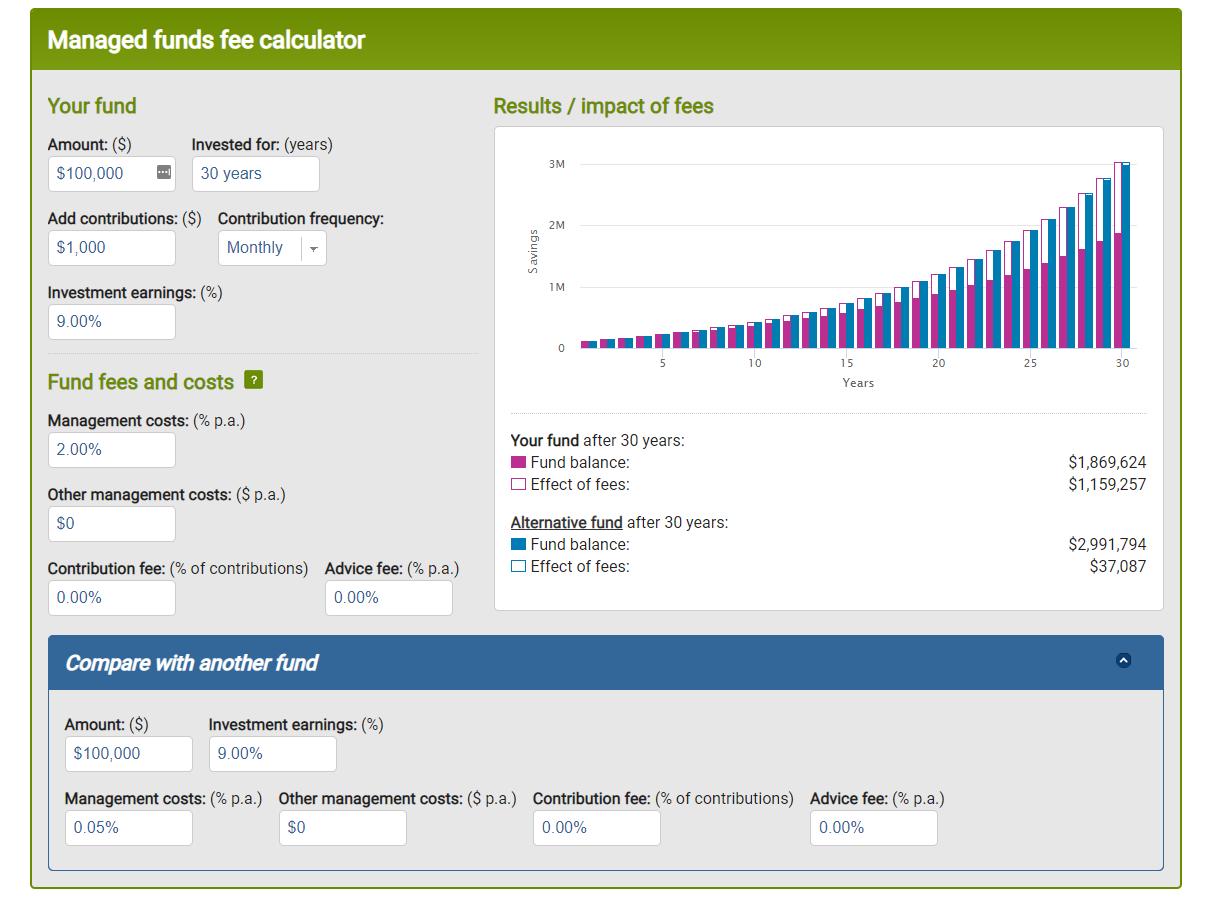
Start Your FI Journey Today
Free calculators, a personalized FI roadmap, and a community of 25K+ on the same journey.
Create a free account to get started
Still Not Convinced? Vanguard’s VTSAX Is Simple
If that staggering $1.1 million fee wasn’t enough to convince you that you should make the switch, perhaps it would help to understand that you CAN make the switch. Moving from an outsourced approach to a DIY approach with Vanguard is incredibly simple. In fact, if you’re worried about having an awkward conversation with your advisor--don't be. You can make the switch and Vanguard will issue a letter on your behalf to release the funds, no weird phone calls with your advisor or tearful breakups, back peddling, or awkwardness needed.
Related: How To Move Money From A Financial Advisor To Vanguard
Build Your FI Plan
Map your path to financial independence with personalized calculators and milestone tracking.
- Save your progress
- Get personalized next steps
- Access calculators and resources
You're in!
Check your email to get started with your FI Plan.
Automating Your Way To Success Without The Middleman
You can begin your account setup online, or call Vanguard to kick off the process. After the transfer is complete, you can then set up automatic deposits to grow your nest egg on a weekly or monthly cadence. While there are some financial barriers to getting started, mainly having enough cash to invest in the funds--you can work your way to get there. To get started with Vanguard’s VTSAX, you’ll need an initial $3,000. If you’re not quite there, they also offer the VTI fund which is a total stock market ETF and has no minimum investment. It can be the perfect starting point for new investors. **Related: How To Open Accounts With Vanguard, Fidelity, And Schwab**Not Just Vanguard
Fidelity and Schwab both offer great mutual funds as well. So if Vanguard isn't your cup of tea don't give up. There are plenty of choices out there. With low-cost index funds, it’s this easy to make giant gains simply by avoiding fees. You don’t need an advanced degree in finance to make the switch, and you can reward yourself with a venti latte with all the add-ons without a twinge of guilt since you’ve literally made that money up in moments of making the switch.
Related Articles
- Vanguard Vs. Fidelity--Which Company Is The Right Choice For You?
- Podcast Episode: Let's Talk About Fees--Why Investment Fees Are Evil And How To Avoid Them
- Is Getting The Lowest Fee The Most Important Part Of Choosing An Index Fund
Find Your FI Number
See where you stand and model your path to financial independence with our free calculator.

You're in!
Check your email to get started with your FI Number.