

Key Takeaways
- Your existing auto insurance policy typically extends to rental cars — your liability, collision, and comprehensive coverage follow you to the rental.
- Premium credit cards (Chase Sapphire Reserve, Amex Platinum) offer primary rental car coverage that pays before your personal auto insurance, avoiding a claim on your personal policy.
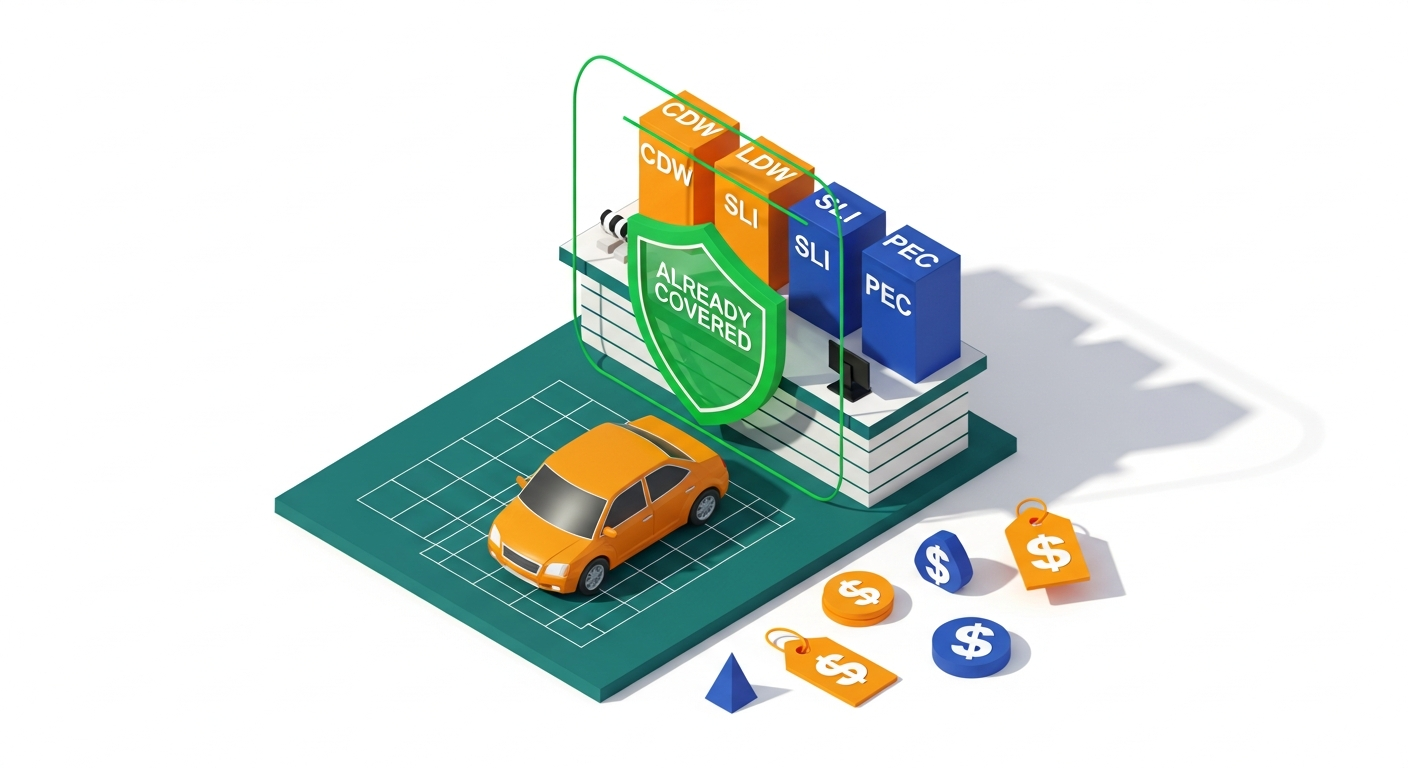
- The rental counter "hard sell" for CDW/LDW, SLI, PAI, and PEC adds $30-$60/day to your rental cost — and most of it duplicates coverage you already have.
- The one scenario where rental counter coverage is essential: renting in a foreign country where your U.S. auto policy and credit card coverage may not apply.
- The FI math: declining unnecessary rental counter insurance saves $150-$420 per week-long rental, which invested over a travel lifetime adds up to thousands in savings.
At a Glance
Key numbers.
Decoding Rental Counter Insurance Options
When you pick up a rental car, the counter agent will offer several insurance products, each with an abbreviation designed to sound essential. Here is what each one actually covers and whether you likely already have it.
Rental Insurance Products Decoded
| Product | Full Name | What It Covers | Daily Cost | You Likely Already Have It From... |
|---|---|---|---|---|
| CDW | Collision Damage Waiver | Damage to the rental car from collision | $15-$30/day | Auto collision coverage + credit card |
| LDW | Loss Damage Waiver | Damage OR theft of rental car | $20-$35/day | Auto collision + comprehensive + credit card |
| SLI | Supplemental Liability Insurance | Injury/damage you cause to others | $10-$15/day | Your auto liability coverage |
| PAI | Personal Accident Insurance | Your medical bills after an accident | $5-$10/day | Your health insurance |
| PEC | Personal Effects Coverage | Theft of belongings from the car | $3-$5/day | Homeowners/renters insurance |
The Overlap Problem
Rental counter insurance is designed to be comprehensive for people with zero existing coverage. But if you have auto insurance, health insurance, homeowners/renters insurance, and a credit card with travel benefits, you likely already have coverage for every scenario the rental counter products address.
Total daily cost of all rental extras: $53-$95/day On a 7-day rental: $371-$665 in unnecessary insurance
That said, there are legitimate scenarios where you need some or all of this coverage — which is why understanding your existing coverage is critical before you decline anything.
What's your FI number? Calculate it in 60 seconds
The one number that changes everything
Your Existing Auto Policy and Rental Cars
Most personal auto insurance policies extend their coverage to rental cars. But the extension is not automatic for every coverage type, and the rules vary by insurer.
How Your Auto Policy Extends to Rentals
| Your Coverage | Extends to Rentals? | Conditions |
|---|---|---|
| Liability (bodily injury + property damage) | Yes — almost always | Rental must be for personal use, not business |
| Collision | Yes — if you carry it | Same deductible applies as your personal policy |
| Comprehensive | Yes — if you carry it | Same deductible applies |
| Uninsured motorist | Yes — usually | Varies by state |
| Medical payments/PIP | Yes — usually | Varies by policy |
Key Limitations
- Rental must be a car or SUV: Many policies exclude exotic cars, large trucks, cargo vans, and specialty vehicles.
- Personal use only: Business rentals may not be covered (check your policy or use your corporate card).
- Geographic limits: Your U.S. auto policy typically covers rentals in the U.S. and Canada. Mexico, international, and island territories may be excluded.
- Rental period limits: Some policies limit coverage to 30-day rentals. Extended rentals may not be covered.
- Your deductible applies: If you have a $1,000 collision deductible, you pay the first $1,000 of any rental car damage. CDW from the rental company or your credit card eliminates this deductible.
- A claim hits YOUR policy: If you use your personal auto insurance for a rental car claim, it goes on YOUR claims history and can increase YOUR premiums. This is the strongest argument for credit card primary coverage.
What If You Do Not Own a Car?
If you do not have personal auto insurance (a common FI strategy in urban areas), you have NO automatic coverage for rental cars. In this case:
- Credit card rental car coverage becomes your primary protection for the vehicle
- You still need liability coverage — buy SLI from the rental company
- Non-owner auto insurance policies ($200-$500/year) provide continuous liability coverage for occasional renters and drivers
Find your FI number in 60 seconds
Free calculator shows when you could reach financial independence — plus a savings rate tracker, expense audit, and more.
Credit Card Rental Car Coverage: Primary vs. Secondary
Credit card rental car coverage is one of the most valuable card benefits for FI-minded travelers, but understanding the primary vs. secondary distinction is crucial.
Primary vs. Secondary Explained
| Feature | Primary Coverage | Secondary Coverage |
|---|---|---|
| When does it pay? | First — before your auto insurance | Only after your auto insurance pays |
| Claim on your auto policy? | No — your auto insurer is never contacted | Yes — must file with auto insurer first |
| Premium impact? | None | Your auto premium may increase |
| Processing time | Faster — single claim | Slower — two-step process |
Credit Card Coverage Comparison
| Card | Coverage Type | Vehicle Types | Geographic Coverage | Rental Period Limit |
|---|---|---|---|---|
| Chase Sapphire Reserve | Primary | Most cars and SUVs | U.S. and most countries | 31 days |
| Chase Sapphire Preferred | Primary | Most cars and SUVs | U.S. and most countries | 31 days |
| Amex Platinum | Secondary (primary if no personal auto policy) | Most cars and SUVs | U.S. and most countries | 30 days |
| Capital One Venture X | Primary | Most cars and SUVs | U.S. and most countries | 30 days |
| Citi Prestige | Primary | Most cars and SUVs | U.S. and most countries | 31 days |
| Most no-annual-fee cards | Secondary or none | Varies | U.S. only or none | Varies |
How to Use Credit Card Coverage
- Decline CDW/LDW at the rental counter — your card replaces this
- Pay for the ENTIRE rental on the card — partial payment voids the benefit
- Decline any rental company insurance that duplicates your card benefit
- Take photos of the car at pickup and return — document any pre-existing damage
- File any claim within 60 days — call the card's benefit administrator, not the card issuer's main line
What Credit Cards Do NOT Cover
| Exclusion | Details |
|---|---|
| Liability to others | Your card covers damage to the RENTAL CAR only — not injury or property damage to others |
| Trucks, vans, specialty vehicles | Most cards exclude vehicles over a certain value or size |
| Off-road use | Damage from driving on unpaved roads or off-road |
| Exotic/luxury cars | Maserati, Lamborghini, etc. are excluded on most cards |
| Consecutive rentals over 31 days | Coverage ends at the 31-day mark |
| Loss of use and diminished value | Some cards exclude the rental company's loss-of-use charges |
How to Save
Review your auto policy rental car extension
Call your auto insurer or read your policy declarations page. Confirm that liability, collision, and comprehensive extend to rental cars. Note your deductible amounts — these apply to rental cars too.
Check your credit card rental car benefits
Download your card Guide to Benefits document. Confirm whether coverage is primary or secondary, which vehicle types are covered, geographic limitations, and the rental period limit.
Always pay for the rental with your best-coverage credit card
The rental must be paid entirely on the card to activate the coverage benefit. Splitting payment between cards or using a debit card can void the coverage.
Decline CDW/LDW if your credit card provides primary coverage
Cards like Chase Sapphire Reserve and Capital One Venture X offer primary CDW that is superior to the rental counter product. Decline the rental counter version.
Keep SLI if you do not own a car
If you have no personal auto policy, you have no liability coverage for rental cars. Your credit card covers vehicle damage only — not injury or property damage to others. Buy SLI or carry a non-owner auto policy.
Photograph the rental car at pickup and return
Document all four sides, the roof, any existing damage, and the odometer. This protects you from fraudulent damage claims by the rental company. Email the photos to yourself for a timestamped record.
Start Your FI Journey Today
Free calculators, a personalized FI roadmap, and a community of 25K+ on the same journey.
Create a free account to get started
Who Needs Rental Car Insurance (And Who Doesn't)
Understanding whether you actually need Rental Car Insurance comes down to a straightforward financial risk assessment. The right answer depends on your specific situation, not a one-size-fits-all rule.
You likely need Rental Car Insurance if you are: travelers whose personal auto insurance, credit card benefits, or travel insurance do not extend to rental vehicles — particularly international travelers, those without personal auto policies, or drivers renting specialty vehicles. In these situations, the coverage fills a genuine financial gap that could otherwise derail your progress toward financial independence.
You can probably skip it if you are: drivers whose existing auto insurance covers rentals at the same level as their own vehicle, or those with premium credit cards that provide primary rental car coverage (Chase Sapphire Reserve, Amex Platinum, Capital One Venture X). When the financial risk you are insuring against is smaller than the cost of the coverage itself, or when you have the resources to absorb the loss, the premium dollars are better directed toward investments.
The core principle is straightforward: insure against catastrophic losses you cannot absorb, and self-insure against losses you can handle. four types available at the counter: Collision Damage Waiver (CDW/LDW) covers vehicle damage, Supplemental Liability covers third-party injuries, Personal Accident covers your injuries, and Personal Effects covers belongings stolen from the car. Ask yourself whether that scenario would meaningfully set back your financial goals. If the answer is yes, the coverage makes sense. If you could recover from the loss using your emergency fund or short-term savings, consider whether check your existing auto policy for rental coverage, use a credit card with primary rental car insurance, or purchase a standalone travel insurance policy that includes rental vehicle coverage.
Build Your FI Plan
Map your path to financial independence with personalized calculators and milestone tracking.
- Save your progress
- Get personalized next steps
- Access calculators and resources
You're in!
Check your email to get started with your FI Plan.
Rental Car Insurance Cost and How to Save
Typical Rental Car Insurance costs run $15-$45/day at the rental counter, which adds $100-$300+ to a week-long rental. However, prices vary significantly based on your location, coverage limits, deductible choices, and the provider you select.
Strategies to reduce your cost:
- Shop multiple providers. Prices for identical coverage can vary by 40-60% between carriers. Get at least 3-5 quotes before committing.
- Bundle with existing policies. Adding coverage to your current auto or homeowners policy is almost always cheaper than buying a standalone policy.
- Choose higher deductibles. Increasing your deductible lowers your premium, and FI-minded individuals with solid emergency funds can absorb the higher out-of-pocket cost.
- Review annually. Your risk profile changes over time — what made sense last year may not be the best fit today.
Use our savings rate calculator to see how optimizing insurance costs affects your overall savings rate. Even modest savings of $200-$500/year compound significantly over a decade of investing. At a 7% average return, $300 saved annually on insurance grows to over $4,400 in ten years — real money that accelerates your FI timeline.
Find Your FI Number
See where you stand and model your path to financial independence with our free calculator.

You're in!
Check your email to get started with your FI Number.
The FI Approach to Rental Car Insurance
For those pursuing financial independence, every insurance decision is a tradeoff between protection and opportunity cost. Rental Car Insurance is no exception.
When this coverage accelerates your FI journey: If you are in the early stages of building wealth and a covered loss would force you into debt or liquidate investments at a loss, Rental Car Insurance acts as a financial guardrail. The relatively small premium protects a much larger pool of assets and keeps your compounding engine intact.
When it slows you down: Once your net worth exceeds the maximum loss this coverage protects against, the premium becomes a drag on your savings rate. The FI-focused approach is to progressively self-insure as your wealth grows. Use our FI number calculator to evaluate where you stand.
The self-insurance framework: Calculate the maximum realistic loss, compare it to your liquid reserves and overall net worth, and ask whether absorbing that loss would change your FI timeline by more than a few months. If the answer is no, self-insuring is the mathematically superior choice. If a loss would set you back by years, the coverage earns its keep.
Build your emergency fund to at least cover your highest insurance deductible, then evaluate whether the coverage itself is still necessary. As your net worth grows, you will naturally outgrow certain insurance products — and that is a sign of genuine financial progress. The FI-focused savings potential from optimizing this coverage is roughly $200-$600+ per trip saved by declining redundant rental counter coverage.
Frequently Asked Questions
In most cases, no. If you have personal auto insurance and a credit card with rental car coverage, you are already covered for vehicle damage, liability, and medical expenses. The rental counter products duplicate coverage you already have at $30-$60/day.
CDW (Collision Damage Waiver) covers damage from collisions only. LDW (Loss Damage Waiver) covers damage from collisions PLUS theft, vandalism, and other non-collision damage. LDW is the more comprehensive product. Most credit cards provide coverage equivalent to LDW.
Most premium cards (Chase Sapphire Reserve, Capital One Venture X) cover rentals in most countries except a few exclusions (Israel, Ireland, Jamaica, and some others vary by card). Always check your card benefits for country-specific exclusions before renting abroad.
Your credit card covers damage to the rental car, but you have no liability coverage for injury or property damage to others. Buy Supplemental Liability Insurance (SLI) at the counter or maintain a non-owner auto policy ($200-$500/year) if you rent cars regularly.
If you have credit card coverage, call the card benefit administrator (not the main card number) to file a claim within 60 days. The card pays for the damage directly. If you used your personal auto insurance, file a claim with your insurer — your deductible applies and the claim may affect your premiums.
The Bottom Line
Most rental car counter insurance is unnecessary if you have personal auto insurance and a credit card with rental car benefits. Your auto policy extends liability, collision, and comprehensive to rentals, while premium credit cards provide primary CDW/LDW that keeps claims off your auto policy. Decline CDW/LDW, PAI, and PEC at the counter. The one exception: if you do not own a car, buy SLI for liability coverage. For international rentals, verify your credit card coverage applies in that country. Declining unnecessary rental insurance saves $150-$420 per week-long rental.
Daily CDW cost at counter
$15–$30
Cards with free coverage
Most Visa/MC
Avg rental damage claim
$3,000