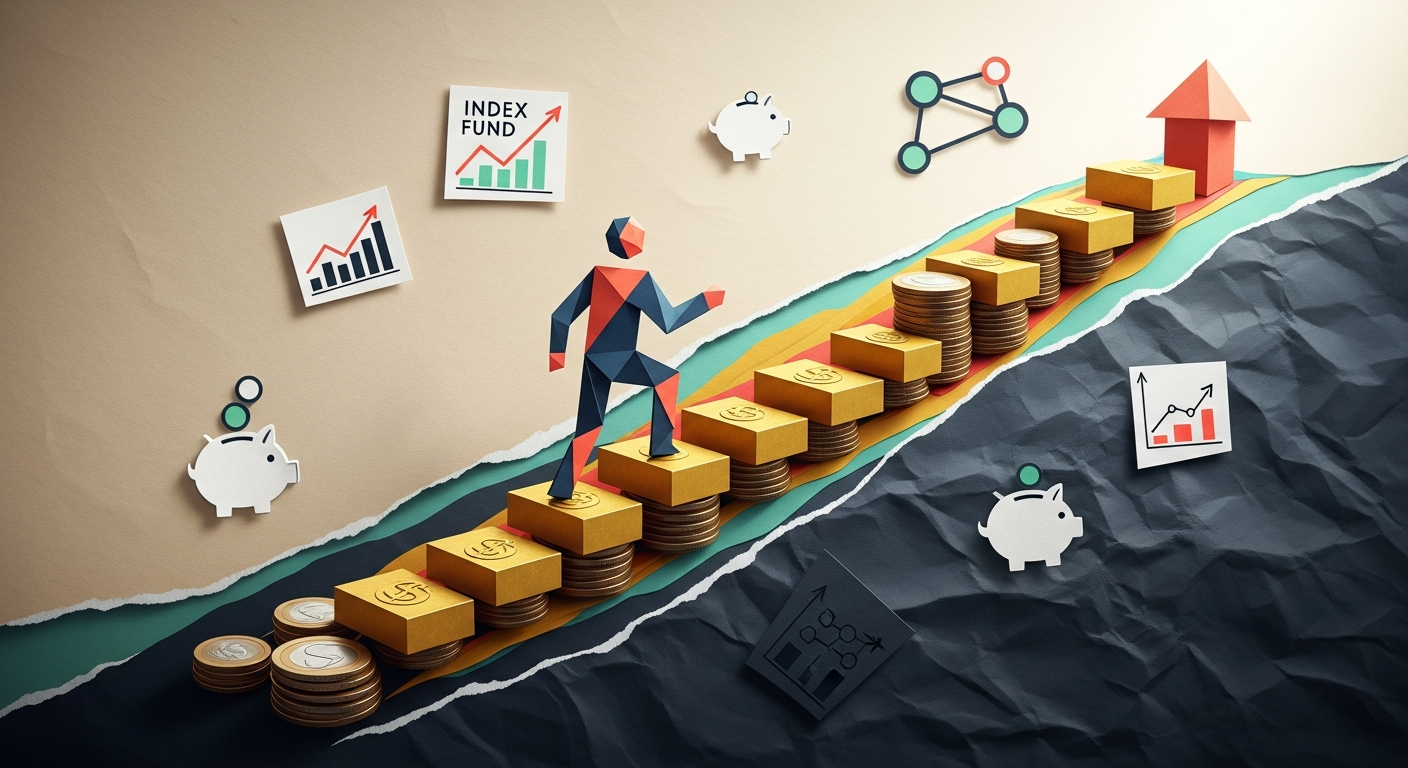
Key Takeaways
- You don't need to be smart, rich, or lucky to invest well — you just need a simple plan
- One low-cost index fund outperforms 90% of professional fund managers over 15 years
- Start with whatever you have — $50 a month is enough to build the habit
- Automate your investments and stop checking your portfolio. Seriously.
What's your FI number? Calculate it in 60 seconds
The one number that changes everything
The Numbers That Matter
You searched "investing for dummies." Good. That takes honesty, and honesty is actually the most important investing skill you can have.
Here's what the financial industry doesn't want you to know: investing well is simple. Not easy — simple. The difference matters. Wall Street makes billions selling complexity: actively managed funds, algorithmic trading, options strategies, and financial advisors who charge 1% of your portfolio to do what you could do yourself in 20 minutes.
The financial independence community figured this out years ago. The data is overwhelming: one low-cost index fund, purchased consistently over time, outperforms 90% of professional money managers. Not some of the time — over virtually every 15-year period ever measured.
This guide is the anti-textbook. No jargon walls. No 47 different account types to memorize. Just the handful of concepts that actually matter, the specific actions to take, and the FI framework that turns investing from "something rich people do" into your personal freedom machine.
If you want the full deep-dive, our beginner's guide to investing and Investing 101 cover every angle. But this page gives you everything you need to get started today.
Why Most Investing Advice Is Overcomplicated
The financial industry has a dirty secret: complexity is how they make money. Every new product, every new strategy, every new "market insight" exists to justify fees. A financial advisor charging 1% per year needs you to believe that investing is too hard to do alone. Spoiler: it isn't.
You don't need to pick stocks. You don't need to time the market. You don't need to read annual reports or watch CNBC or have an opinion on interest rates. The FI community has proven, with thousands of real-world examples, that the simplest approach wins.
Where Is Your Money Going?
Our free Expense Audit tool breaks down your spending by category and reveals exactly where you can save more. Create a free account to start.
- Category-by-category spending breakdown with visual charts
- Savings potential analysis — see where you can cut without pain
- Track spending month over month and celebrate wins
Free forever — no credit card required
Monthly Spending
$4,180
Potential savings: $620/mo identified
Spending by Category
$4,180
Spending
$620
Can Save
$7,440
Per Year
Preview — create free account to use
The Only 5 Investing Concepts You Actually Need
Forget everything you've heard about investing being complicated. There are exactly five concepts that matter. Everything else is noise designed to sell you something.
1. Compound Growth — Your Money Makes Money
Compound growth is the single most powerful force in investing. When your investments earn returns, those returns earn returns, and those returns earn returns. It's an exponential curve that gets steeper over time.
Here's what $500 per month invested at a 7% average annual return looks like:
- After 10 years: ~$86,000 (you contributed $60,000)
- After 20 years: ~$260,000 (you contributed $120,000)
- After 30 years: ~$567,000 (you contributed $180,000)
Notice the pattern: after 30 years, more than two-thirds of your wealth is growth, not contributions. Time is the key ingredient. Starting now — even with small amounts — matters more than starting later with larger amounts.
2. Index Funds — Own the Whole Market for Almost Nothing
An index fund is a single investment that owns hundreds or thousands of companies at once. Instead of trying to pick which stocks will go up (spoiler: even professionals can't do this consistently), you own all of them.
The total US stock market index fund gives you ownership in about 3,500 companies — Apple, Google, your local bank, everything — for an annual fee of 0.03%. That's $3 per year for every $10,000 invested.
3. Asset Allocation — Your Age-Based Mix
Asset allocation is just a fancy term for "how much in stocks vs bonds." A common rule of thumb: 110 minus your age equals your stock percentage. If you're 30, that's 80% stocks and 20% bonds.
The FI community often goes more aggressive — 90-100% stocks — especially early in the accumulation phase, because they have a long time horizon and can tolerate market drops.
4. Tax-Advantaged Accounts — Free Money and Tax Breaks
Before you invest a single dollar, make sure it's going into the right account:
- 401(k) with employer match — if your employer matches 50% up to 6%, that's an instant 50% return. Don't leave this on the table.
- HSA — the triple-tax-advantaged account that most people underuse
- Roth IRA — tax-free growth forever, with income limits to know about
5. Dollar-Cost Averaging — Automate and Forget
Set up automatic monthly investments and stop trying to time the market. When prices drop, your fixed dollar amount buys more shares. When prices rise, you buy fewer. Over time, this averages out to a very competitive entry price — and removes the emotional decision-making that destroys most investors' returns.
The 5 Investing Concepts That Actually Matter
Everything else is noise.
Compound Growth
Your money earns returns, and those returns earn returns. $500/month at 7% becomes over $567,000 in 30 years — most of that is growth, not your contributions.
Index Funds
Own the entire stock market for 0.03% per year. One fund gives you 3,500+ companies and beats 90% of professional managers.
Asset Allocation
Simple rule: 110 minus your age in stocks, rest in bonds. Many in the FI community go 90-100% stocks early in their accumulation phase.
Tax-Advantaged Accounts
401(k) employer match is free money. Roth IRA grows tax-free. HSA has triple tax benefits. Use them in the right order.
Dollar-Cost Averaging
Invest the same amount every month regardless of market conditions. You buy more shares when prices drop, fewer when they rise. Automation removes emotion.
What to Actually Buy — The One-Fund Solution
Here's where most investing guides lose people: too many choices. Let's cut through it.
The Total Stock Market Index Fund
If you want the single simplest investing strategy that works, buy one of these:
- VTSAX (Vanguard Total Stock Market Index Fund) — 0.03% expense ratio
- FSKAX (Fidelity Total Market Index Fund) — 0.015% expense ratio
- SWTSX (Schwab Total Stock Market Index Fund) — 0.03% expense ratio
One purchase. 3,500+ companies. Instant diversification. Annual cost of $3-$15 per $10,000 invested. This is the approach championed by Jack Bogle, the founder of Vanguard, and it has outperformed the vast majority of professional money managers for decades.
Our guide to the best low-cost index funds covers additional options, but any of these three will serve you well for your entire investing career.
The Three-Fund Portfolio
Once you're comfortable, you can graduate to a three-fund portfolio for slightly more diversification:
- US Total Stock Market (60-70%) — VTSAX, FSKAX, or SWTSX
- International Stock Market (20-30%) — VTIAX, FTIHX, or SWISX
- US Bond Market (0-20%) — VBTLX, FXNAX, or SWAGX
The exact percentages depend on your age and risk tolerance. If you're in your 20s or 30s and building toward FI, many in the community skip bonds entirely. If you're within 5-10 years of your FI date, a 10-20% bond allocation adds stability. For more on index funds vs ETFs, we've got you covered.
Start Your FI Journey Today
Free calculators, a personalized FI roadmap, and a community of 25K+ on the same journey.
Create a free account to get started
One-Fund vs Three-Fund Portfolio
| One-Fund (Total Market) | Three-Fund Portfolio | |
|---|---|---|
| Simplicity | ★★★★★ | ★★★★ |
| Diversification | ★★★★ | ★★★★★ |
| Control | ★★ | ★★★★ |
| Best For | Total beginners | Slightly more engaged investors |
| Our Pick | Start here | Graduate to this |
One-Fund (Total Market)
Three-Fund Portfolio
How to Start Investing Today
You can finish this in one afternoon.
Open a Brokerage Account
15 minutesChoose Fidelity, Vanguard, or Schwab — all three are free, reputable, and offer the index funds you need. This takes about 15 minutes online.
Pro tip: Fidelity has zero minimums. Vanguard requires $3,000 for VTSAX but offers ETF equivalents (VTI) with no minimum.
Set Up Automatic Monthly Transfers
10 minutesLink your bank account and schedule automatic transfers on payday. Start with whatever you can — $50, $100, $500. The amount matters less than the consistency.
Pro tip: Automate it so you never have to make the decision each month. Remove willpower from the equation.
Buy a Total Stock Market Index Fund
5 minutesVTSAX (Vanguard), FSKAX (Fidelity), or SWTSX (Schwab). One purchase gives you ownership in 3,500+ companies for 0.03% per year.
Pro tip: If your account balance is small, buy the ETF version (VTI, ITOT, SCHB) — same fund, no minimum.
Turn On Dividend Reinvestment (DRIP)
2 minutesThis automatically reinvests any dividends back into the fund. Compound growth works best when every dollar stays invested.
Don't Look at It for a Year
0 minutesSeriously. The biggest risk to your returns is your own behavior. Set it, forget it, and let compound growth work. Check back in a year — you'll be glad you did.
Pro tip: Market drops are normal. A 10% correction happens roughly once a year. Stay the course.
Insurance in Ohio
Coverage guides and savings tips for your state.
Fidelity vs Vanguard vs Schwab
| Fidelity | Vanguard | Schwab | |
|---|---|---|---|
| Account Minimum | $0 | $0 ($3K for VTSAX) | $0 |
| Total Market Fund | FSKAX (0.015%) | VTSAX (0.03%) | SWTSX (0.03%) |
| Best For | No minimums + research | Simplicity + investor-owned | Banking integration |
Fidelity
Vanguard
Schwab
The Biggest Investing Mistakes Beginners Make
Knowing what to do is half the battle. Knowing what NOT to do is the other half. Here are the mistakes that cost beginners the most money.
Trying to Pick Individual Stocks
It feels productive. It feels like you're being smart. But the data is brutal: over a 15-year period, about 90% of actively managed mutual funds — run by people with MBAs, Bloomberg terminals, and decades of experience — underperform a simple index fund. If the pros can't beat the market consistently, picking stocks in your spare time is not a winning strategy.
Paying High Fees
A 1% annual management fee sounds tiny. It's not. On a $500,000 portfolio over 30 years, the difference between a 1% fee and a 0.03% fee is over $300,000 in lost growth. That's not a rounding error — it's a house. Or several years of financial independence.
Waiting for the "Right Time" to Start
People have been waiting for the market to drop before investing since the market existed. The problem: you can't predict when drops will happen, and every day you wait is a day your money isn't compounding. Time in the market beats timing the market — the data on this is overwhelming.
If you're worried about starting with a large sum, start investing with little money and increase your contributions as your income grows.
Panic Selling During Market Drops
The stock market has dropped 10%+ roughly once per year, on average, since its inception. It has also recovered from every single one of those drops and gone on to reach new highs. Selling during a downturn locks in your losses and guarantees you miss the recovery. The investors who do best are the ones who do nothing during market turbulence.
Overcomplicating It
You don't need 15 funds, 3 brokerages, a financial advisor, and a subscription to Morningstar. One fund, one account, automatic contributions. That's it. Complexity is the enemy of execution.
Build Your FI Plan
Map your path to financial independence with personalized calculators and milestone tracking.
- Save your progress
- Get personalized next steps
- Access calculators and resources
You're in!
Check your email to get started with your FI Plan.
Investing for Dummies — The FI Perspective
Investing Isn't About Getting Rich — It's About Buying Freedom
In the FI community, investing has a specific purpose: building a portfolio large enough that its returns cover your living expenses forever. That's it. Not Lamborghinis. Not mansions. Freedom.
The formula is simple: 25 times your annual expenses = your FI number. If you spend $40,000 per year, you need $1,000,000 invested. Spend $60,000? You need $1,500,000. This is based on the 4% safe withdrawal rate — one of the most researched rules in personal finance.
Every dollar you invest is a tiny employee working for you 24 hours a day, 7 days a week, generating returns while you sleep. Enough tiny employees, and you never have to trade your time for money again.
How Long Does It Take?
Here's the part most people get wrong: your savings rate matters far more than your investment returns. Someone saving 50% of their income reaches FI in roughly 17 years regardless of whether the market returns 5% or 8%. Someone saving 10% needs 50+ years no matter what.
This is why the FI community obsesses over the gap between income and spending rather than stock picks. The math is clear: earn more, spend less, invest the difference in index funds, and time does the rest.
What's your FI number? Calculate it in 60 seconds
The one number that changes everything
Savings Rate vs Years to Financial Independence
How fast you save matters more than what you earn
| Savings Rate | Years to FI | What It Means |
|---|---|---|
Assumes 5% real returns and starting from $0. Based on the FI community's standard savings rate model.
Find Your FI Number
See where you stand and model your path to financial independence with our free calculator.

You're in!
Check your email to get started with your FI Number.

Top Travel Card
Ready to unlock a world of free travel? Start with the Chase Sapphire Preferred® Card
$95 annual fee | Earn 75,000 bonus points

Best Card for Side Hustlers and Business Owners
Side hustlers! With the Ink Business Preferred® Credit Card you can earn free travel from your business expenses.
$95 annual fee | Earn 100,000 bonus points

Most Flexible Travel Card
The Capital One Venture Rewards Credit Card can be used to offset almost any travel expense.
$95 annual fee | Earn more than $1,000 in Travel Bonuses with a limited-time $300 Capital One Travel stays credit, plus earn 75,000 bonus miles once you spend $4,000 on purchases within the first 3 months of account opening—that's more than $1,000 in travel value
ChooseFI has partnered with CardRatings for our coverage of credit card products. ChooseFI and CardRatings may receive a commission from card issuers.
Frequently Asked Questions
Investing in diversified index funds is one of the safest long-term wealth-building strategies available. While the stock market drops in any given year about 25% of the time, it has never lost money over any 20-year period in history. The risk isn't investing — it's NOT investing and losing purchasing power to inflation.
As little as $1. Fidelity has no minimum investment requirements, and most brokerages offer fractional shares. The FI community's advice: start with whatever you have and increase over time. Consistency matters more than amount.
It depends on the interest rate. Always get your 401(k) employer match first — it's free money. Then pay off any debt above 6-7% interest before investing more. For debt below 4-5% (like many mortgages), you can invest simultaneously — index fund returns historically exceed low-interest debt costs.
A stock is ownership in one company. An index fund is ownership in thousands of companies at once. When you buy VTSAX, you own a tiny piece of Apple, Google, and 3,500+ other companies. If one company fails, the others keep growing. That's diversification.
A Roth IRA is a tax-advantaged retirement account: your money grows tax-free and withdrawals in retirement are tax-free. A regular brokerage account has no tax benefits but also no withdrawal restrictions or income limits. Most FI seekers use both.
For a total stock market index fund to go to zero, every publicly traded company in America would have to go bankrupt simultaneously. That has never happened and is essentially impossible. Individual stocks can go to zero. Index funds cannot, practically speaking.
These can be part of a portfolio, but they shouldn't be your starting point. Index funds are simpler, more diversified, and have the longest track record of reliable returns. Once you've built a solid index fund foundation, you can consider adding alternative investments.
You have several excellent options: a Solo 401(k) (allows up to $72,000/year in contributions), a SEP IRA (up to 25% of net self-employment income), or a regular Roth IRA. Many self-employed FI seekers use a Solo 401(k) as their primary vehicle because of the high contribution limits.
Investing Approaches for Beginners: Pros and Cons
- Index fund investing is proven — outperforms 90% of professionals over 15 years with near-zero effort
- Automation removes emotional decision-making that destroys most investors' returns
- Tax-advantaged accounts (401k, HSA, Roth IRA) multiply your returns through tax savings
- Dollar-cost averaging means you never need to time the market or predict anything
- Starting with as little as $50/month builds the habit — the amount matters less than consistency
- Market drops of 10-30% happen regularly and test emotional discipline, especially for new investors
- Simple index fund approach feels boring — the temptation to overcomplicate is constant
- Tax-advantaged accounts have withdrawal restrictions that limit access before retirement age
- The one-fund approach means accepting market-average returns — you will never beat the market
- Building meaningful wealth takes decades of consistency — no shortcuts or hacks
The Bottom Line
Investing isn't complicated — and you don't need to be a financial expert to do it well. Buy a low-cost total stock market index fund, automate your monthly contributions, and let compound growth do the heavy lifting. The FI community has proven this approach works for thousands of people across every income level. The only mistake is waiting to start.
Recommended Fund
VTSAX
Expense Ratio
0.03%
Time to Start
Today