Login
Financial Independence

Savings rate, FI number, and the path to freedom.

Retirement Strategies

Withdrawal plans, Roth ladders, and early access.

Investing

Index funds, asset allocation, and real estate.

Tax Strategies

Roth conversions, capital gains, and FI tax planning.

Earning More

Career growth, side hustles, and entrepreneurship.

Money Mindset

Beliefs, purpose, and financial psychology.

Health & Fitness

Exercise, nutrition, and mental wellness.

Risk based guardrails w/o using Firecalc?

Risk based guardrails w/o using Firecalc?

dm7
dm7 364 XP · · 15 replies

Is there a way to use Aubrey William's risk based guardrails calculator without using firecalc? The reason I ask is that the portfolio options in firecalc do not include anything beyond the most basic choice of stocks and bonds. No gold, REITs etc…. Has anybody figured a way to do the risk based guardrails math with another simulator like portfolio visualizer or test folio?

OR has anybody figured a way to use Firecalc with a portfolio including alternative assets like gold, REITs and managed futures?

Share
Share on Facebook
Share on X
Share on Reddit
Share via Email
Copy link

How close are you to financial independence?

Use our free calculator to find your target number and see how your withdrawal strategy stacks up.

Calculate Your FI Number

Replies (15)

laurenboland

laurenboland

1 month ago

https://fireproofme.com

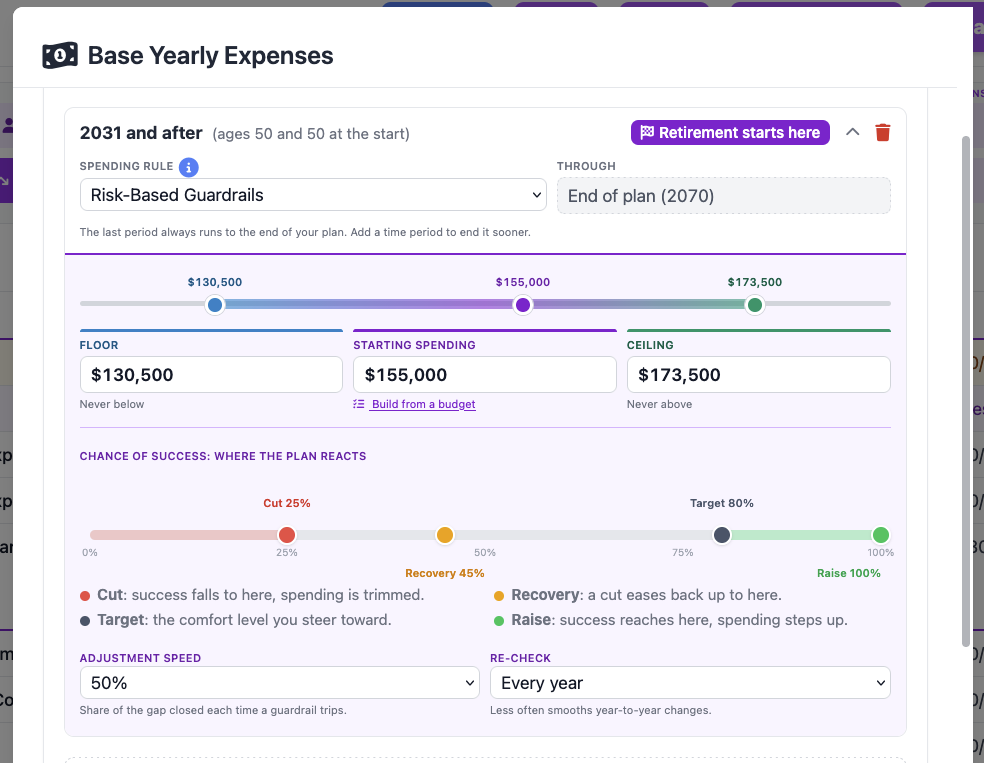
has Risk-based guardrails as a spending plan that can be used in the Retirement Years. It does the solver math on each year, as you go.

dm7

dm7

309 XP

1 month ago

cool tool. I like the interface. But it's got the same problems that Firecalc has. The asset classes are very limited.

laurenboland

laurenboland

1 month ago

Define "limited"?

  • S&P500 composite ("Equities")
  • US 10-yr Treasury ("Bonds")
  • Gold
  • US Large Cap Growth
  • US Large Cap Value
  • US Small Cap Blend
  • International Developed
  • US Total Market (VTSAX)
  • TIPS (including TIPS ladders)
  • US Intermediate Treasury (FRED DGS5)

And the ability to upload your own datasets to create assets. A lot of that is gated by the subscription, but it opens a lot of doors.

dm7

dm7

309 XP

1 month ago

Those asset classes cover less than 50% of my portfolio. I'm not sure how or where I'd find data sets to upload for the missing parts.

laurenboland

laurenboland

1 month ago

Ah, I got you. That's fair.

I'm just curious, what sort of assets are not on that list? I know that a lot of the tools out there face licensing issues with datasets if they are parts of big indexes, and if they are individual assets there can be issues with merging that kind of data in with a historical analysis meant to go back 100+ years if asset data doesn't line up.

That's kind of why you see a lot of the more general asset classes.

dm7

dm7

309 XP

1 month ago

Long term treasuries, US small cap value, REITs & managed futures.

Because none of the monte carlo simulations really capture all of the asset classes or have very limited data sets, I think the risk based guardrails approach just isn't practical from an ease of use stand point for me. I'm sorta resigned to using something more like the Guyton Klinger style guardrails. It's just easier to track and implement

bermiesanders

bermiesanders

271 XP

1 month ago

dm7

dm7

309 XP

1 month ago

Looks like the same idea and also has similar limitations. Only 7 asset classes to choose from.

Charlotte

Charlotte

1,407 XP

1 month ago

This the tool that he (and others) and built:

https://fire-guardrails.streamlit.app
dm7

dm7

309 XP

1 month ago

Unless I'm mistaken, that tool is even more limited in that the portfolio can only have a mix of two assets (US stocks and 10 year treasuries)

UncleFrank

UncleFrank

1,457 XP

1 month ago

You will find that any variable withdrawal strategy such as guardrails, a Kitces Ratchet or similar tends to have similar effects on most portfolios.

So if you know that "this strategy tends to improve the safe withdrawal rate of a simple 60/40 portfolio by 0.7%" over the base "Bengen-type" assumptions, you are likely to get similar results for other portfolios.

The reason for this is that a variable withdrawal strategy has little or nothing to do with the portfolio construction itself – it applies as if the portfolio is just a black box with an output that goes up or down.

This calculator at Portfolio Charts allow you to apply all kinds of variable withdrawal strategies to a variety of portfolios and customize the strategy to various guardrails and other things. Check it out.

dm7

dm7

309 XP

1 month ago

Yes I understand. I'm trying to incorporate some sort of guardrail strategy to my withdrawals policy in decumulation. A friend suggested using the risk based methods that Aubrey Williams has outlined in various presentations, podcasts, etc… The triggers for Aubrey's guardrails and how much to adjust withdrawals are calculated by the portfolio's historical chance of success. As you know, different portfolio asset allocations have different historical chances of success. Therefore the portfolio construction is somewhat crucial in deciding what triggers the change in withdrawals and how much to adjust the withdrawal amount. In his tutorial for figuring this all out he uses Firecalc. If you monkey with the portfolio in Firecalc you will get wildly different results. No surprise there. Unfortunately, Firecalc doesn't allow for you to enter alternatives like gold and managed futures. I'm just looking for some sort of work around.

I've played with the guardrail tool on portfolio charts and it's very cool but the triggers are all based on how much the portfolio is up or down and not on the chance of success. Also it doesn't factor in for social security.

UncleFrank

UncleFrank

1,457 XP

1 month ago

I would not plan on adjusting your withdrawals like that in retirement – it does not actually comport with the way people actually live (or should live if they want to live their best lives). But this is the inherent problem with variable withdrawal strategies that are too complex and keyed off of performance and not real life concerns.

More human-based variable strategies that people actually use focus on the expense side, and on two factors. First, separating mandatory from discretionary expenses. A good guideline there is 60% or less in the mandatory category. Second, adjusting for actual personal inflation, not the CPI. If you are an average retiree, adjusting only for personal inflation tends to raise the effective SWR by 0.5-1.0%.

Our retirement experience is that we can spend anywhere from 4-6% on average in any given year and it really doesn't matter since our target is 5%. It comes out in the wash over years. But we would NEVER "not take that vacation" based on what some complicated guardrails strategy dictated to us.

For a good survey of different kinds of variable withdrawal strategies and how they affect portfolios, see the annual Morningstar reports. Here is the most recent one.

dm7

dm7

309 XP

1 month ago

I read "Section III: How Dynamic Withdrawal Strategies Can Help" from the paper that you linked. They do include the risk based guardrails in their study. That method appeared to perform very well. It supported one of the highest safe withdrawal rate and highest spending over the 30 year test period. It left the least amount unspent. So if you are die with zero kind or person it might be a good strategy for you.

The problem I see is that the free simulation / backtest apps on the internets are difficult to use with a diverse number of asset classes.

UncleFrank

UncleFrank

1,457 XP

1 month ago

I think you missed the point(s). First, there were two guardrails strategies tested, a very simple Guyton-Klinger and a very complex probability-based version. Now look at Exhibit 15. They both performed about the same, albeit both with relatively high standard deviations. What this tells you is that there is little benefit to adopting a very complicated guardrails strategy when a simpler one will do. (But financial advisors like to plug the more complicated ones to give you something to pay for – listen to that happening on the Sep 17 White Coat Investor podcast for an example. This is the latest, greatest marketing schtick many have landed on.)

But also look at the base withdrawal rates in Exhibit 15. Despite their complexities and high variability, neither of the guardrails strategies really performed significantly better than the dirt-simple "Actual Spending" strategy in terms of starting withdrawals. They all added just over 1% to the standard SWR.

The "Actual Spending" strategy is based on the observation that real retirees do not experience inflation at the CPI rate, but 1-2% less than that. So all you need to do to see if you qualify and implement that is monitor your own spending to see how it increases over time. You are probably doing that anyway.

Our retirement experience is that our lifestyle costs have actually been declining, not going up, and the only exceptions are discretionary items like renovations and big vacations.

But if you were to combine "Actual Spending" with a simple Guyton-Klinger, you can have the best of both worlds. No complex calculations will be necessary. (This is similar to what most people actually do in real life anyway.)

Don't confuse complexity with efficacy. "More calculating" with fancy formulas does not yield better results here. There is more than one way to skin the variable withdrawal strategy cat, so don't limit yourself to only one idea.


Showing 4 of 15 replies

View all replies on Community

Comments

Your comment will be posted after signing in
Join the Conversation

Create an account or sign in to post a comment.

Retirement Withdrawal Strategies

You've reached Financial Independence—now what? This guide walks you through how to access your money efficiently in retirement. Explore withdrawal sequences, tax optimization, Roth conversions, and strategies to make your savings last a lifetime.

Retirement Withdrawal Strategies Guide
Retirement Withdrawal Strategies: The Guide

Read our complete guide to get up to speed.

From a Recent FI Weekly
“If you’re at Fidelity investing $500/month into a Vanguard mutual fund, you might be losing almost 10% of every contribution before it’s even invested.”

Plus more counterintuitive insights, real stories, and actionable strategies — every Tuesday.

Join 87,000+ people. Free. Unsubscribe anytime.

Track Your Progress to Financial Independence

Get your personalized FI number and track how close you are to reaching your milestones. Most members are closer than they think.

Personalized FI number calculation

Track progress to Coast FI & full FI

Live dashboard updates as you hit milestones

or

100% free — no credit card required

Account created! Redirecting...

Try searching for

⌘K to open anytime

Where Are You on the Path to FI?

1/3

Step 1 of 3

Which of these sounds most like you?

Scan to get the app

Point your phone camera at the QR code